Ch. 17 - Reactions of Aromatic Compounds
Wade - Organic Chemistry 9th Edition
Wade9th EditionOrganic ChemistryISBN: 9780135213728Not the one you use?Change textbook
Chapter 17, Problem 30a

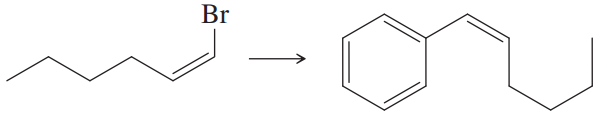
Show how you would use Suzuki reactions to synthesize these products from the indicated starting materials. You may use any additional reagents you need.
(a) Synthesis diagram showing a brominated alkene converting to a biphenyl product via a Suzuki reaction.

Verified step by step guidance
1
Step 1: Identify the Suzuki reaction components. The Suzuki reaction involves coupling an organoboron compound with an organohalide (such as bromides) in the presence of a palladium catalyst and a base. In this case, the starting material is an alkyl bromide, and the product contains a substituted benzene ring.
Step 2: Prepare the organoboron compound. To synthesize the desired product, you need an organoboron reagent that matches the substituent on the benzene ring. In this case, you would use an alkylboronic acid or alkylboronate ester with the same alkyl chain as the product (e.g., butylboronic acid).
Step 3: Set up the Suzuki coupling reaction. Combine the alkyl bromide starting material with the organoboron compound in the presence of a palladium catalyst (e.g., Pd(PPh3)4) and a base (e.g., K2CO3 or NaOH) in a suitable solvent such as tetrahydrofuran (THF) or water.
Step 4: Ensure the reaction conditions are optimized. Heat the reaction mixture gently to promote the coupling reaction, typically at 50–80°C. The palladium catalyst facilitates the formation of the carbon-carbon bond between the alkyl group and the benzene ring.
Step 5: Purify the product. After the reaction is complete, isolate the product by standard organic workup techniques, such as extraction, drying, and purification via column chromatography or recrystallization, to obtain the desired substituted benzene compound.

Verified video answer for a similar problem:

This video solution was recommended by our tutors as helpful for the problem above.
Video duration:
3m
Was this helpful?

Key Concepts

Here are the essential concepts you must grasp in order to answer the question correctly.

Suzuki Coupling Reaction

The Suzuki coupling reaction is a widely used method in organic chemistry for forming carbon-carbon bonds. It involves the reaction of an organoboron compound with an organic halide in the presence of a palladium catalyst and a base. This reaction is particularly valuable for synthesizing biaryl compounds, as it allows for the coupling of aryl groups, which is essential in the production of complex organic molecules.
Recommended video:
Guided course
04:02
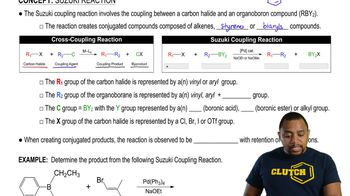
Suzuki Reaction

Organoboron Compounds

Organoboron compounds are organic molecules that contain boron atoms bonded to carbon. They are key intermediates in the Suzuki reaction, typically used as nucleophiles. Common examples include arylboronic acids and esters, which can react with various electrophiles, such as aryl halides, to form new carbon-carbon bonds, facilitating the synthesis of complex structures.
Recommended video:
Guided course
01:40
Defining meso compounds.

Palladium Catalysis

Palladium catalysis is crucial in many cross-coupling reactions, including the Suzuki reaction. Palladium serves as a catalyst that facilitates the transfer of the aryl group from the organoboron compound to the organic halide. The catalytic cycle involves several steps, including oxidative addition, transmetalation, and reductive elimination, which ultimately lead to the formation of the desired product while regenerating the palladium catalyst.
Recommended video:
2:31
Nucleophilic Catalysis Concept 1