Ch. 20 - The Organic Chemistry of Carbohydrates
Bruice - Organic Chemistry 8th Edition
Bruice8th EditionOrganic ChemistryISBN: 9780135213711Not the one you use?Change textbook
Chapter 21, Problem 45

The disaccharide lactulose consists of a D-galactopyranose subunit and a D-fructofuranose subunit joined by a β-1,4′-glycosidic linkage. After treatment of lactulose with 1. excess CH3I/Ag2O, 2. HCl/H2O, the d-galactopyranose subunit was found to have one nonmethylated OH group, whereas the D-fructofuranose subunit had two. Draw the structure of ⍺-lactulose.

Verified step by step guidance
1
Step 1: Understand the structure of lactulose. Lactulose is a disaccharide composed of two monosaccharides: d-galactopyranose and d-fructofuranose. These are connected by a β-1,4′-glycosidic linkage. The β-1,4′ linkage means the anomeric carbon of d-galactopyranose is connected to the fourth carbon of d-fructofuranose.
Step 2: Analyze the reaction conditions. The treatment with CH3I/Ag2O methylates all free hydroxyl (-OH) groups in the molecule. This means that any hydroxyl group not involved in the glycosidic bond will be converted to a methoxy (-OCH3) group. The subsequent treatment with HCl/H2O hydrolyzes the glycosidic bond, breaking the disaccharide into its monosaccharide components.
Step 3: Determine the number of nonmethylated hydroxyl groups. After methylation and hydrolysis, the d-galactopyranose subunit has one nonmethylated hydroxyl group, and the d-fructofuranose subunit has two. This indicates that the glycosidic bond involves one hydroxyl group from each monosaccharide, leaving the remaining hydroxyl groups free for methylation.
Step 4: Draw the structure of α-lactulose. Start by drawing the d-galactopyranose subunit in its pyranose (six-membered ring) form, ensuring the hydroxyl groups are positioned correctly. Then, draw the d-fructofuranose subunit in its furanose (five-membered ring) form. Connect the anomeric carbon of d-galactopyranose to the fourth carbon of d-fructofuranose via a β-1,4′-glycosidic bond.
Step 5: Verify the stereochemistry and functional groups. Ensure the stereochemistry of the hydroxyl groups on both monosaccharides matches their natural configurations. Confirm that the glycosidic bond is correctly represented as β-1,4′ and that the remaining hydroxyl groups are free for methylation during the reaction.

Verified video answer for a similar problem:

This video solution was recommended by our tutors as helpful for the problem above.
Video duration:
4m
Was this helpful?

Key Concepts

Here are the essential concepts you must grasp in order to answer the question correctly.

Glycosidic Linkage

A glycosidic linkage is a type of covalent bond that connects two monosaccharides to form a disaccharide. In the case of lactulose, the bond is specifically a β-1,4' glycosidic linkage, indicating the orientation of the bond between the anomeric carbon of one sugar and the hydroxyl group of another. Understanding this linkage is crucial for determining the structure and properties of the resulting disaccharide.
Recommended video:
Guided course
12:17
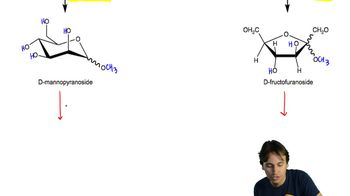
Predict the structure of the glycoside products

Monosaccharide Structure

Monosaccharides, the building blocks of carbohydrates, can exist in different forms, such as pyranose (six-membered ring) and furanose (five-membered ring). In lactulose, d-galactopyranose and d-fructofuranose are the two monosaccharide units. Recognizing the structural differences and functional groups of these monosaccharides is essential for understanding their reactivity and the overall structure of lactulose.
Recommended video:
Guided course
06:06
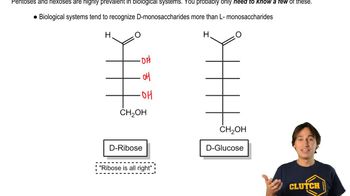
Monosaccharides - Common Structures

Methylation and Hydrolysis

Methylation is a chemical reaction that involves the addition of a methyl group (CH3) to a molecule, often affecting its reactivity and solubility. In the context of lactulose, treatment with CH3I/Ag2O followed by HCl/H2O leads to selective methylation and hydrolysis, revealing the number of nonmethylated hydroxyl groups on each monosaccharide. This process is important for analyzing the structure and functional groups present in the disaccharide.
Recommended video:
1:00
Hydrolysis of Thioesters Concept 2