Ch. 20 - The Organic Chemistry of Carbohydrates
Bruice - Organic Chemistry 8th Edition
Bruice8th EditionOrganic ChemistryISBN: 9780135213711Not the one you use?Change textbook
Chapter 21, Problem 46

A hexose was obtained after (+)-glyceraldehyde underwent three successive Kiliani–Fischer syntheses. Identify the hexose from the following experimental information: oxidation with nitric acid forms an optically active aldaric acid; a Wohl degradation followed by oxidation with nitric acid forms an optically inactive aldaric acid; and a second Wohl degradation forms erythrose.

Verified step by step guidance
1
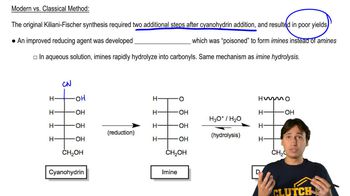
Step 1: Understand the Kiliani–Fischer synthesis. This reaction extends the carbon chain of an aldose by one carbon atom, creating a pair of epimers at the new stereocenter. Since ( + )-glyceraldehyde is the starting material, it undergoes three successive Kiliani–Fischer syntheses, resulting in a hexose with multiple stereocenters.
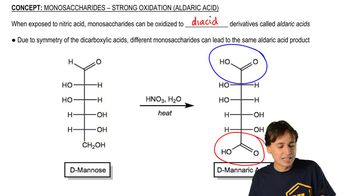
Step 2: Analyze the oxidation with nitric acid. Oxidation of the hexose with nitric acid converts both the aldehyde group and the terminal primary alcohol group into carboxylic acids, forming an aldaric acid. The fact that the aldaric acid is optically active indicates that the hexose is not symmetric, meaning it has a chiral center arrangement that does not result in a meso compound.
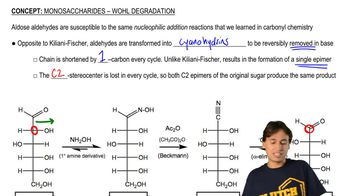
Step 3: Examine the first Wohl degradation. The Wohl degradation shortens the carbon chain of the hexose by one carbon atom, converting it into a pentose. Oxidation of this pentose with nitric acid forms an optically inactive aldaric acid. This indicates that the pentose is symmetric, meaning it is a meso compound. This symmetry provides a clue about the stereochemistry of the hexose.
Step 4: Analyze the second Wohl degradation. A second Wohl degradation shortens the pentose into a tetrose, specifically erythrose. Erythrose is a known compound with a specific stereochemistry, and this information helps backtrack the stereochemical configuration of the original hexose.
Step 5: Combine all the information. Based on the experimental data (optically active aldaric acid from the hexose, optically inactive aldaric acid from the pentose, and erythrose from the tetrose), deduce the stereochemistry of the hexose. The hexose must be D-mannose, as it fits all the given experimental observations and stereochemical requirements.

Verified video answer for a similar problem:

This video solution was recommended by our tutors as helpful for the problem above.
Video duration:
12m
Was this helpful?

Key Concepts

Here are the essential concepts you must grasp in order to answer the question correctly.

Kiliani–Fischer Synthesis

The Kiliani–Fischer synthesis is a method for elongating carbon chains in aldoses, allowing the formation of new hexoses from smaller sugars. This reaction involves the addition of a cyanide ion to an aldehyde, followed by hydrolysis to yield a new aldose. Understanding this process is crucial for determining the structure of the hexose produced from glyceraldehyde.
Recommended video:
Guided course
03:57
Monosaccharides - Kiliani-Fischer

Aldaric Acids

Aldaric acids are dicarboxylic acids derived from aldoses through oxidation of both the aldehyde and hydroxyl groups. The formation of optically active and inactive aldaric acids in the question indicates the stereochemical properties of the original hexose. Recognizing the relationship between the hexose and its corresponding aldaric acid is essential for identifying the sugar.
Recommended video:
Guided course
03:10
Monosaccharides - Strong Oxidation (Aldaric Acid)

Wohl Degradation

Wohl degradation is a chemical reaction that allows for the conversion of aldoses into smaller sugars, typically by cleaving the sugar into two parts. This process is significant in the context of the question, as it provides insights into the structure of the original hexose based on the products formed after degradation. The ability to trace back the transformations helps in identifying the hexose from the experimental data.
Recommended video:
Guided course
09:43
Monosaccharides - Wohl Degradation