
Ch. 20 - The Organic Chemistry of Carbohydrates
Bruice - Organic Chemistry 8th Edition
Bruice8th EditionOrganic ChemistryISBN: 9780135213711Not the one you use?Change textbook
Chapter 21, Problem 47

Draw the mechanism for the interconversion of α-D-glucose and β-D-glucose in dilute HCl.

Verified step by step guidance
1
Step 1: Recognize that the interconversion of α-D-glucose and β-D-glucose occurs through a process called mutarotation, which involves the opening of the cyclic form of glucose into its linear form and subsequent re-cyclization.
Step 2: In the presence of dilute HCl, the acid acts as a catalyst. Protonate the oxygen atom of the hemiacetal group in α-D-glucose to make it a better leaving group. This step forms an oxonium ion.
Step 3: The oxonium ion undergoes bond cleavage, leading to the opening of the glucose ring and forming the linear form of glucose, which contains an aldehyde group. This step is reversible.
Step 4: The linear form of glucose can then undergo re-cyclization. The hydroxyl group on C-5 attacks the carbonyl carbon (C-1) to form a new hemiacetal. Depending on the direction of attack, either α-D-glucose or β-D-glucose is formed.
Step 5: The process of ring opening and re-cyclization continues until an equilibrium mixture of α-D-glucose and β-D-glucose is established. The β-anomer is typically more stable and present in higher amounts due to reduced steric hindrance in its chair conformation.

Verified video answer for a similar problem:

This video solution was recommended by our tutors as helpful for the problem above.
Was this helpful?

Key Concepts

Here are the essential concepts you must grasp in order to answer the question correctly.

Anomeric Carbon

The anomeric carbon is the carbon atom in a sugar that is bonded to two oxygen atoms, one of which is part of a hydroxyl group and the other is part of the ring structure. In the case of glucose, this is carbon 1. The configuration of the anomeric carbon determines whether the sugar is in the alpha (α) or beta (β) form, which is crucial for understanding the interconversion process.
Recommended video:
Guided course
02:12
Carbonation of Grignard Reagents

Hemiacetal Formation

Hemiacetals are formed when an alcohol reacts with an aldehyde or ketone. In the case of glucose, the cyclic form of the sugar is a hemiacetal, where the hydroxyl group on the anomeric carbon can either be positioned above (β) or below (α) the plane of the ring. This concept is essential for understanding how α-D-glucose can convert to β-D-glucose through the opening and closing of the ring structure.
Recommended video:
Guided course
06:23
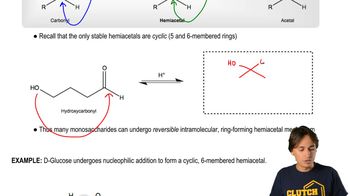
Monosaccharides - Forming Cyclic Hemiacetals

Acid-Catalyzed Equilibrium

In the presence of dilute HCl, the interconversion between α-D-glucose and β-D-glucose occurs through an acid-catalyzed equilibrium. The acid protonates the hydroxyl group on the anomeric carbon, facilitating the ring-opening to form an open-chain aldehyde, which can then re-cyclize to form either anomer. This mechanism highlights the role of acid in promoting the interconversion process.
Recommended video:
Guided course
03:09
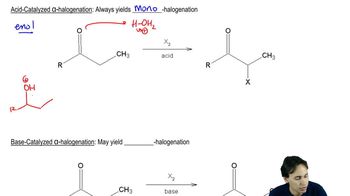
Acid Catalyzed
Related Practice
Textbook Question

The disaccharide lactulose consists of a D-galactopyranose subunit and a D-fructofuranose subunit joined by a β-1,4′-glycosidic linkage. After treatment of lactulose with 1. excess CH3I/Ag2O, 2. HCl/H2O, the d-galactopyranose subunit was found to have one nonmethylated OH group, whereas the D-fructofuranose subunit had two. Draw the structure of ⍺-lactulose.

Textbook Question

A hexose was obtained after (+)-glyceraldehyde underwent three successive Kiliani–Fischer syntheses. Identify the hexose from the following experimental information: oxidation with nitric acid forms an optically active aldaric acid; a Wohl degradation followed by oxidation with nitric acid forms an optically inactive aldaric acid; and a second Wohl degradation forms erythrose.

Textbook Question

Treatment with sodium borohydride converts aldose A to an optically inactive alditol. Wohl degradation of A forms B, whose alditol is optically inactive. Wohl degradation of B forms D-glyceraldehyde. Identify A and B.

1
views
Textbook Question

Hyaluronic acid, a component of connective tissue, is the fluid that lubricates joints. It is a polymer of alternating N-acetyl-D-glucosamine and D-glucuronic acid subunits joined by β-1,3′-glycosidic linkages. Draw a short segment of hyaluronic acid.

2
views
Textbook Question

A D-aldopentose is oxidized by nitric acid to an optically active aldaric acid. A Wohl degradation of the aldopentose leads to a monosaccharide that is oxidized by nitric acid to an optically inactive aldaric acid. Identify the D-aldopentose.

1
views
Textbook Question

Draw the mechanism for the formation of β-lactose from ⍺-D-galactose and β-D-glucose in dilute HCl.

4
views