Ch.4 - The Study of Chemical Reactions
Wade - Organic Chemistry 9th Edition
Wade9th EditionOrganic ChemistryISBN: 9780135213728Not the one you use?Change textbook
Chapter 4, Problem 46a

In the presence of a small amount of bromine, the following light-promoted reaction has been observed.
Chemical reaction showing allylic bromination with bromine and light, producing two products and HBr.
a. Write a mechanism for this reaction. Your mechanism should explain how both products are formed. (Hint: Notice which H atom has been lost in both products.)

Verified step by step guidance
1
Step 1: Recognize that the reaction is a free radical halogenation reaction promoted by light (hv). Bromine (Br2) undergoes homolytic cleavage under light to form two bromine radicals (Br•). This is the initiation step.
Step 2: Identify the hydrogen atoms that are abstracted in the products. In the first product, the hydrogen atom from the methyl group is abstracted, while in the second product, the hydrogen atom from the allylic position (next to the double bond) is abstracted. These positions are key to understanding the mechanism.
Step 3: Explain the propagation steps. The bromine radical (Br•) abstracts a hydrogen atom from the methyl group or the allylic position of the starting compound, forming a carbon radical. The carbon radical then reacts with another Br2 molecule to form the brominated product and regenerate a bromine radical.
Step 4: Discuss the stability of the intermediates. The allylic radical is stabilized by resonance, making it more likely to form the second product. The methyl radical is less stable but still forms the first product due to the availability of the methyl hydrogen.
Step 5: Conclude with the termination step. Two bromine radicals can combine to form Br2, or other radical combinations can occur, but these are less relevant to the formation of the observed products. The reaction overall produces two brominated products and HBr as a byproduct.

Verified video answer for a similar problem:

This video solution was recommended by our tutors as helpful for the problem above.
Video duration:
5m
Was this helpful?

Key Concepts

Here are the essential concepts you must grasp in order to answer the question correctly.

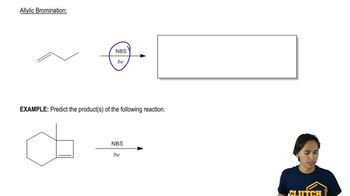
Allylic Bromination

Allylic bromination is a reaction where bromine (Br2) adds to the allylic position of an alkene or alkane, typically in the presence of light or heat. This process involves the abstraction of a hydrogen atom from the allylic position, leading to the formation of a radical intermediate. The radical can then react with bromine to form brominated products, resulting in a mixture of products due to the possibility of bromination at different allylic positions.
Recommended video:
Guided course
00:54
Mechanism of Allylic Bromination.

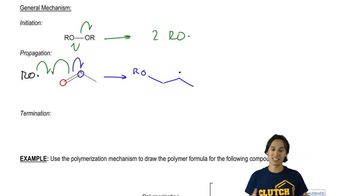
Radical Mechanism

The radical mechanism involves three main steps: initiation, propagation, and termination. In the initiation step, light or heat generates bromine radicals from Br2. During propagation, these radicals abstract hydrogen atoms from the substrate, forming new radicals that can react with bromine to create brominated products. This mechanism is crucial for understanding how both products in the reaction are formed, as it explains the formation of different brominated species.
Recommended video:
Guided course
03:28
The mechanism of Radical Polymerization.

Selectivity in Radical Reactions

Selectivity in radical reactions refers to the preference for a radical to abstract a hydrogen atom from a specific position, leading to different products. In allylic bromination, the stability of the resulting radical influences which hydrogen is abstracted. More stable radicals (like tertiary over secondary or primary) are favored, which can lead to a mixture of products, as seen in the reaction where both products are formed from different hydrogen atoms being lost.
Recommended video:
Guided course
10:08
Radical selectivity:Alcoholics Anonymous Version