Ch. 17 - Reactions at the Alpha-Carbon
Bruice - Organic Chemistry 8th Edition
Bruice8th EditionOrganic ChemistryISBN: 9780135213711Not the one you use?Change textbook
Chapter 18, Problem 7f

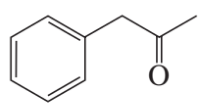
Draw the enol tautomers for each of the following compounds. For compounds that have more than one enol tautomer, indicate the one that is more stable.
f. Chemical structure showing enol tautomers with a phenyl group and a carbonyl, indicating stability of one tautomer.

Verified step by step guidance
1
Step 1: Identify the keto group in the compound. The keto group is the carbonyl group (C=O) attached to the ring structure.
Step 2: Recall the concept of keto-enol tautomerism. This is an equilibrium process where a hydrogen atom shifts from an alpha-carbon (adjacent to the carbonyl group) to the oxygen atom of the carbonyl group, forming an enol (a compound with a hydroxyl group attached to a double-bonded carbon).
Step 3: Locate the alpha-hydrogens in the compound. These are hydrogens attached to the carbons adjacent to the carbonyl group. In this case, there are alpha-hydrogens on both sides of the carbonyl group.
Step 4: Draw the possible enol tautomers. For each alpha-hydrogen, move the hydrogen to the oxygen atom of the carbonyl group and form a double bond between the alpha-carbon and the carbonyl carbon. This will result in two possible enol tautomers.
Step 5: Determine the more stable enol tautomer. Stability is influenced by factors such as conjugation and hydrogen bonding. In this case, the enol tautomer that forms a conjugated system with the aromatic ring is more stable due to resonance stabilization.

Verified video answer for a similar problem:

This video solution was recommended by our tutors as helpful for the problem above.
Video duration:
4m
Was this helpful?

Key Concepts

Here are the essential concepts you must grasp in order to answer the question correctly.

Tautomerization

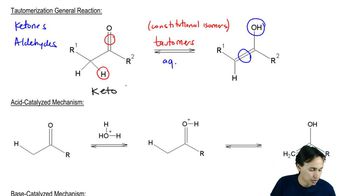
Tautomerization is a chemical reaction that involves the transfer of a proton and a shift of a double bond, resulting in the interconversion between two isomers known as tautomers. In organic chemistry, this often occurs between keto and enol forms, where the keto form contains a carbonyl group (C=O) and the enol form has a hydroxyl group (–OH) adjacent to a double bond. Understanding this process is crucial for predicting the stability and reactivity of compounds.
Recommended video:
Guided course
05:11
Tautomerization Mechanisms

Enol Stability

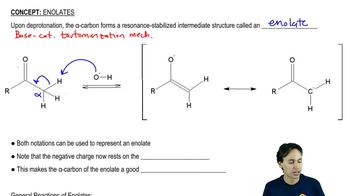
The stability of enol tautomers can vary significantly based on factors such as intramolecular hydrogen bonding, steric hindrance, and resonance stabilization. Enols that can form strong hydrogen bonds or have resonance structures that delocalize charge are generally more stable. Recognizing these factors helps in determining which enol tautomer is favored in a given reaction or compound.
Recommended video:
Guided course
02:26
Formation of Enolates

Keto-Enol Equilibrium

Keto-enol equilibrium refers to the dynamic balance between the keto and enol forms of a compound. The position of this equilibrium is influenced by temperature, solvent, and the presence of catalysts. In many cases, the keto form is more thermodynamically stable, but under certain conditions, the enol form may be favored, especially in reactions involving electrophiles or nucleophiles. Understanding this equilibrium is essential for predicting the behavior of organic compounds in various chemical contexts.
Recommended video:
Guided course
02:26
Formation of Enolates