Ch. 17 - Reactions at the Alpha-Carbon
Bruice - Organic Chemistry 8th Edition
Bruice8th EditionOrganic ChemistryISBN: 9780135213711Not the one you use?Change textbook
Chapter 18, Problem 14a

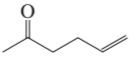
How could each of the following compounds be prepared from a ketone and an alkyl halide?
a. 4

Verified step by step guidance
1
Step 1: Identify the target compound. The structure provided is a ketone with an alkyl group containing a double bond attached to the alpha-carbon. This suggests the use of an alkylation reaction.
Step 2: Select the starting ketone. The ketone in the target compound is cyclopentanone, which will serve as the starting material.
Step 3: Choose the alkyl halide. The alkyl group attached to the alpha-carbon contains a double bond, indicating that the alkyl halide should be allyl bromide (CH2=CH-CH2Br).
Step 4: Use a base to generate the enolate ion from the ketone. A strong base such as sodium hydride (NaH) or LDA (Lithium Diisopropylamide) can be used to deprotonate the alpha-carbon of cyclopentanone, forming the enolate ion.
Step 5: Perform the alkylation reaction. React the enolate ion with allyl bromide in an SN2 reaction to attach the allyl group to the alpha-carbon of cyclopentanone, forming the target compound.

Verified video answer for a similar problem:

This video solution was recommended by our tutors as helpful for the problem above.
Video duration:
2m
Was this helpful?

Key Concepts

Here are the essential concepts you must grasp in order to answer the question correctly.

Enolate Formation

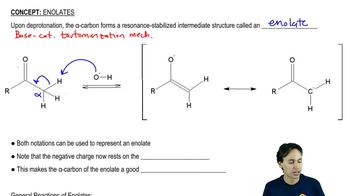
Enolates are nucleophilic species formed from the deprotonation of a carbonyl compound, such as a ketone. This process typically involves a strong base that abstracts an alpha-hydrogen, resulting in a resonance-stabilized anion. Enolates are crucial intermediates in organic synthesis, particularly in reactions like alkylation, where they can react with alkyl halides to form new carbon-carbon bonds.
Recommended video:
Guided course
02:26
Formation of Enolates

Alkylation of Enolates

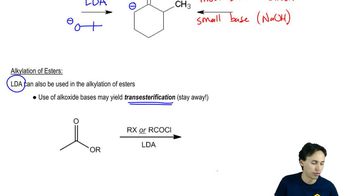
Alkylation of enolates involves the reaction of an enolate ion with an alkyl halide to form a new carbon-carbon bond. This reaction is typically carried out under conditions that favor the formation of the enolate, followed by the nucleophilic attack on the electrophilic carbon of the alkyl halide. The choice of alkyl halide can influence the regioselectivity and stereochemistry of the resulting product.
Recommended video:
Guided course
03:05
Enolates of Esters

Synthesis of Carbonyl Compounds

The synthesis of carbonyl compounds from ketones and alkyl halides often involves multiple steps, including enolate formation and subsequent alkylation. This strategy allows for the construction of complex molecules by introducing new alkyl groups at specific positions. Understanding the reactivity of both the ketone and the alkyl halide is essential for predicting the outcome of the synthesis and for optimizing reaction conditions.
Recommended video:
Guided course
01:40
Defining meso compounds.