Ch. 17 - Reactions at the Alpha-Carbon
Bruice - Organic Chemistry 8th Edition
Bruice8th EditionOrganic ChemistryISBN: 9780135213711Not the one you use?Change textbook
Chapter 18, Problem 11a

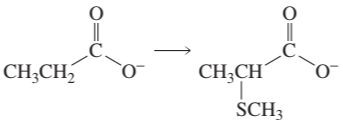
Show how the following compounds can be prepared from the given starting material:
a. Chemical reaction showing the conversion of a carboxylate to a thioether with a methyl group.

Verified step by step guidance
1
Step 1: Analyze the starting material, 3-methylbutanoate, and the target compound, 3-methyl-2-(methylthio)butanoate. Notice that the target compound has a methylthio (-SCH3) group added to the alpha-carbon (the carbon adjacent to the carbonyl group). This suggests a nucleophilic substitution or addition reaction at the alpha-carbon.
Step 2: To activate the alpha-carbon for substitution, perform an alpha-halogenation reaction. Treat the starting material with a halogen (e.g., Br2 or Cl2) in the presence of a base (e.g., NaOH). This will replace one of the alpha-hydrogens with a halogen atom, forming 3-methyl-2-halo-butanoate.
Step 3: Introduce the methylthio group (-SCH3) by performing a nucleophilic substitution reaction. Use a nucleophile such as sodium methanethiolate (NaSCH3) to replace the halogen atom at the alpha-carbon with the methylthio group. This step converts 3-methyl-2-halo-butanoate into 3-methyl-2-(methylthio)butanoate.
Step 4: Ensure the reaction conditions are mild to avoid side reactions. For example, use an appropriate solvent like ethanol or acetone to facilitate the nucleophilic substitution reaction.
Step 5: Purify the product using techniques such as distillation or recrystallization to isolate 3-methyl-2-(methylthio)butanoate in its pure form.

Verified video answer for a similar problem:

This video solution was recommended by our tutors as helpful for the problem above.
Video duration:
2m
Was this helpful?

Key Concepts

Here are the essential concepts you must grasp in order to answer the question correctly.

Nucleophilic Substitution

Nucleophilic substitution is a fundamental reaction mechanism in organic chemistry where a nucleophile attacks an electrophile, resulting in the replacement of a leaving group. In the context of the given reaction, the nucleophile (methylthio group) attacks the carbon atom of the 3-methylbutanoate that is bonded to the leaving group, facilitating the formation of the desired product.
Recommended video:
Guided course
01:47
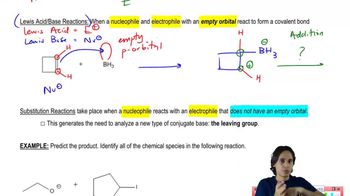
Nucleophiles and Electrophiles can react in Substitution Reactions.

Carboxylic Acid Derivatives

Carboxylic acid derivatives, such as esters and thioesters, are compounds that can be derived from carboxylic acids by replacing the hydroxyl group with another functional group. Understanding these derivatives is crucial for predicting the reactivity and transformation of compounds like 3-methylbutanoate into 3-methyl-2-(methylthio)butanoate, as they often undergo nucleophilic substitution reactions.
Recommended video:
Guided course
03:50
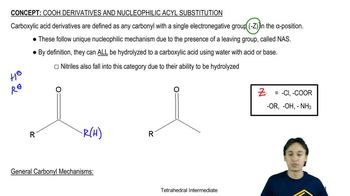
Intro to Carboxylic Acid Derivatives

Reaction Mechanisms

A reaction mechanism describes the step-by-step process by which reactants are converted into products, detailing the formation and breaking of bonds. In this case, analyzing the mechanism of the nucleophilic substitution will help in understanding how the methylthio group is introduced into the 3-methylbutanoate structure, leading to the formation of the target compound.
Recommended video:
Guided course
02:16
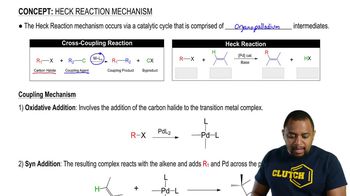
Heck Reaction Mechanism