Ch.6 - Alkyl Halides; Nucleophilic Substitution
Wade - Organic Chemistry 9th Edition
Wade9th EditionOrganic ChemistryISBN: 9780135213728Not the one you use?Change textbook
Chapter 6, Problem 16c,d

For each pair, predict the stronger nucleophile in the SN2 reaction (using an alcohol as the solvent). Explain your prediction.
c. NH3 or PH3
d. CH3S or H2S

Verified step by step guidance
1
Understand the concept of nucleophilicity: Nucleophilicity refers to the ability of a species to donate a pair of electrons to an electrophile. In SN2 reactions, stronger nucleophiles react faster. Factors affecting nucleophilicity include charge, electronegativity, solvent effects, and the size of the nucleophile.
Analyze the solvent: The problem specifies that the solvent is an alcohol, which is a polar protic solvent. Polar protic solvents can hydrogen bond with nucleophiles, stabilizing them and reducing their nucleophilicity. Larger, less electronegative atoms are less affected by this stabilization, making them stronger nucleophiles in polar protic solvents.
Compare NH3 and PH3: Nitrogen (N) is smaller and more electronegative than phosphorus (P). In a polar protic solvent, NH3 will be more stabilized by hydrogen bonding than PH3. Since PH3 is less stabilized, it will be the stronger nucleophile in this solvent.
Compare CH3S⁻ and H2S: CH3S⁻ is negatively charged, while H2S is neutral. Negatively charged species are generally stronger nucleophiles than their neutral counterparts. Additionally, sulfur (S) is larger and less electronegative than oxygen, so CH3S⁻ will be less stabilized by the polar protic solvent compared to H2S, making CH3S⁻ the stronger nucleophile.
Summarize the predictions: For part (c), PH3 is the stronger nucleophile in an alcohol solvent. For part (d), CH3S⁻ is the stronger nucleophile due to its negative charge and reduced stabilization in the polar protic solvent.

Verified video answer for a similar problem:

This video solution was recommended by our tutors as helpful for the problem above.
Video duration:
5m
Was this helpful?

Key Concepts

Here are the essential concepts you must grasp in order to answer the question correctly.

Nucleophilicity

Nucleophilicity refers to the ability of a species to donate an electron pair to an electrophile during a chemical reaction. In SN2 reactions, stronger nucleophiles are typically negatively charged or have lone pairs that can readily participate in bond formation. Factors influencing nucleophilicity include charge, electronegativity, and solvent effects, with polar protic solvents often stabilizing nucleophiles and reducing their reactivity.
Recommended video:
Guided course
08:27
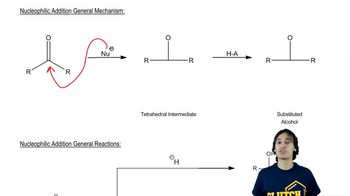
Nucleophilic Addition

SN2 Mechanism

The SN2 (substitution nucleophilic bimolecular) mechanism involves a single concerted step where the nucleophile attacks the electrophile, leading to the displacement of a leaving group. This reaction is characterized by a backside attack, resulting in inversion of configuration at the carbon center. The rate of the reaction depends on the concentration of both the nucleophile and the substrate, making it bimolecular.
Recommended video:
Guided course
08:33
Drawing the SN2 Mechanism

Solvent Effects

The choice of solvent can significantly influence the nucleophilicity of reactants in an SN2 reaction. In polar protic solvents, such as alcohols, nucleophiles can be stabilized through hydrogen bonding, which can hinder their reactivity. Conversely, polar aprotic solvents do not solvate anions as effectively, often leading to increased nucleophilicity. Understanding how solvents interact with nucleophiles is crucial for predicting reaction outcomes.
Recommended video:
Guided course
01:16
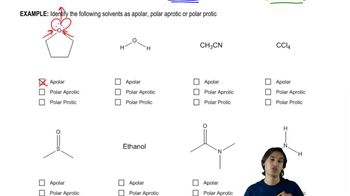
Identification of polarity in solvents