Ch.6 - Alkyl Halides; Nucleophilic Substitution
Wade - Organic Chemistry 9th Edition
Wade9th EditionOrganic ChemistryISBN: 9780135213728Not the one you use?Change textbook
Chapter 6, Problem 15e,f,g

Show how you might use SN2 reactions to convert 1-chlorobutane into the following compounds.
e. CH3—(CH2)3—C≡CH
f. CH3CH2—O—(CH2)3—CH3
g. CH3—(CH2)3—NH2

Verified step by step guidance
1
Step 1: Begin with 1-chlorobutane (CH3—(CH2)3—Cl), which is a primary alkyl halide suitable for SN2 reactions due to minimal steric hindrance.
Step 2: For compound e (CH3—(CH2)3—C≡CH), use sodium acetylide (NaC≡CH) as the nucleophile. The acetylide ion will attack the carbon bonded to the chlorine in an SN2 reaction, replacing the chlorine with the acetylide group.
Step 3: For compound f (CH3CH2—O—(CH2)3—CH3), use sodium ethoxide (NaOCH2CH3) as the nucleophile. The ethoxide ion will perform an SN2 attack on the carbon bonded to chlorine, substituting the chlorine with the ethoxy group.
Step 4: For compound g (CH3—(CH2)3—NH2), use ammonia (NH3) as the nucleophile. Ammonia will attack the carbon bonded to chlorine in an SN2 reaction, replacing the chlorine with an amino group. Excess ammonia may be used to prevent over-alkylation.
Step 5: Ensure reaction conditions favor SN2 mechanisms by using polar aprotic solvents (e.g., acetone or DMSO) and maintaining low steric hindrance around the electrophilic carbon.

Verified video answer for a similar problem:

This video solution was recommended by our tutors as helpful for the problem above.
Video duration:
6m
Was this helpful?

Key Concepts

Here are the essential concepts you must grasp in order to answer the question correctly.

SN2 Reactions

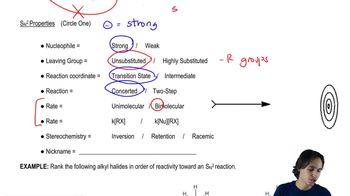
SN2 (Substitution Nucleophilic Bimolecular) reactions involve a nucleophile attacking an electrophilic carbon atom, resulting in the simultaneous displacement of a leaving group. This mechanism is characterized by a single concerted step, where the nucleophile approaches the carbon from the opposite side of the leaving group, leading to inversion of configuration. Understanding SN2 is crucial for predicting the outcomes of reactions involving primary alkyl halides like 1-chlorobutane.
Recommended video:
Guided course
11:57
Understanding the properties of SN2.

Nucleophiles

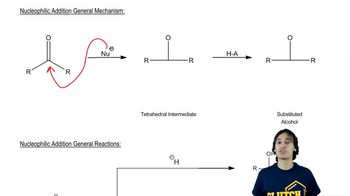
Nucleophiles are species that donate an electron pair to form a chemical bond in a reaction. They are typically negatively charged or neutral molecules with lone pairs of electrons. In the context of SN2 reactions, strong nucleophiles are essential for effectively displacing the leaving group from the substrate. Examples include alkynes, alcohols, and amines, which can be derived from 1-chlorobutane through nucleophilic substitution.
Recommended video:
Guided course
08:27
Nucleophilic Addition

Leaving Groups

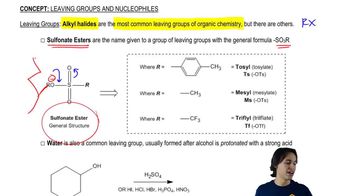
Leaving groups are atoms or groups that can depart from the substrate during a chemical reaction, allowing for the formation of new bonds. A good leaving group is typically stable after departure and can be a halide ion (like Cl- from 1-chlorobutane) or other groups such as tosylate or mesylate. The ability of a leaving group to stabilize its negative charge is critical in determining the feasibility of an SN2 reaction.
Recommended video:
Guided course
07:22
The 3 important leaving groups to know.