Ch.6 - Alkyl Halides; Nucleophilic Substitution
Wade - Organic Chemistry 9th Edition
Wade9th EditionOrganic ChemistryISBN: 9780135213728Not the one you use?Change textbook
Chapter 6, Problem 16e,f

For each pair, predict the stronger nucleophile in the SN2 reaction (using an alcohol as the solvent). Explain your prediction.
e. (CH3)3N or (CH3)2O
f. CH3COO or CF3COO

Verified step by step guidance
1
Step 1: Understand the concept of nucleophilicity in SN2 reactions. Nucleophilicity refers to the ability of a species to donate a pair of electrons to an electrophile. In SN2 reactions, nucleophilicity is influenced by factors such as charge, electronegativity, steric hindrance, and solvent effects.
Step 2: Analyze the pair (CH3)3N vs. (CH3)2O. (CH3)3N is a neutral amine, while (CH3)2O is a neutral ether. Amines are generally better nucleophiles than ethers because nitrogen is less electronegative than oxygen, making nitrogen more willing to donate its lone pair of electrons. Additionally, steric hindrance in (CH3)3N is moderate, but it is still less hindered compared to the oxygen in (CH3)2O.
Step 3: Consider the solvent effect. Alcohol solvents are protic, meaning they can form hydrogen bonds with nucleophiles. Protic solvents tend to stabilize nucleophiles through hydrogen bonding, which can reduce their nucleophilicity. However, the relative nucleophilicity of (CH3)3N vs. (CH3)2O remains consistent due to the inherent properties of nitrogen and oxygen.
Step 4: Analyze the pair CH3COO- vs. CF3COO-. Both are carboxylate anions, but their nucleophilicity is influenced by the electron-withdrawing effects of substituents. CF3COO- has three highly electronegative fluorine atoms attached to the carbon adjacent to the carboxylate group, which strongly withdraws electron density and stabilizes the negative charge on the oxygen. This stabilization reduces its nucleophilicity compared to CH3COO-, which has a less electron-withdrawing methyl group.
Step 5: Summarize the predictions. For pair (e), (CH3)3N is the stronger nucleophile due to nitrogen's lower electronegativity compared to oxygen. For pair (f), CH3COO- is the stronger nucleophile because it is less stabilized by electron-withdrawing groups compared to CF3COO-.

Verified video answer for a similar problem:

This video solution was recommended by our tutors as helpful for the problem above.
Video duration:
7m
Was this helpful?

Key Concepts

Here are the essential concepts you must grasp in order to answer the question correctly.

Nucleophilicity

Nucleophilicity refers to the ability of a species to donate an electron pair to an electrophile during a chemical reaction. In SN2 reactions, stronger nucleophiles are typically negatively charged or have lone pairs that can readily participate in bond formation. Factors influencing nucleophilicity include charge, electronegativity, and steric hindrance.
Recommended video:
Guided course
08:27
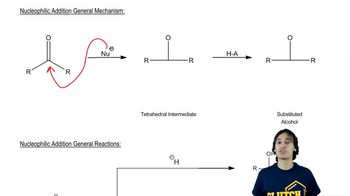
Nucleophilic Addition

Solvent Effects in SN2 Reactions

The choice of solvent can significantly impact the rate and outcome of SN2 reactions. Polar protic solvents, like alcohols, can stabilize nucleophiles through hydrogen bonding, which may reduce their reactivity. Conversely, polar aprotic solvents enhance nucleophilicity by solvation effects, allowing nucleophiles to remain more reactive.
Recommended video:
Guided course
01:16
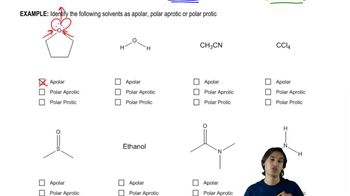
Identification of polarity in solvents

Steric Hindrance

Steric hindrance refers to the prevention of reactions due to the spatial arrangement of atoms within a molecule. In SN2 reactions, bulky groups around the nucleophile can hinder its approach to the electrophile, making it less effective. Therefore, less sterically hindered nucleophiles are generally stronger and more favorable in these reactions.
Recommended video:
Guided course
02:53
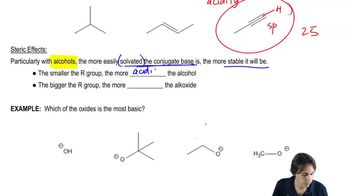
Understanding steric effects.