Ch. 27 - Carbohydrates, Nucleic Acids, and Lipids
Mullins - Organic Chemistry: A Learner Centered Approach 1st Edition
Mullins1st EditionOrganic Chemistry: A Learner Centered ApproachISBN: 9780137566471Not the one you use?Change textbook
Chapter 26, Problem 34b

Predict the product of each of the following reactions.
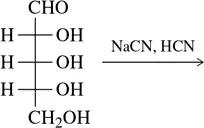
(b) Structural formula of a monosaccharide with reaction conditions NaCN and HCN indicated for product prediction.

Verified step by step guidance
1
Identify the functional groups present in the starting material. The structure shown is a sugar, specifically an aldose, with an aldehyde group (CHO) at the top and multiple hydroxyl (OH) groups along the carbon chain.
Recognize the reagents used in the reaction: NaCN and HCN. These are used to perform a cyanohydrin formation reaction, where the cyanide ion (CN-) will attack the carbonyl carbon of the aldehyde group.
Understand the mechanism: The cyanide ion (CN-) acts as a nucleophile and attacks the electrophilic carbon of the aldehyde group, resulting in the formation of a tetrahedral intermediate.
Protonation of the alkoxide ion (formed in the intermediate) by HCN leads to the formation of a cyanohydrin, where the original aldehyde group is converted into a hydroxyl group and a nitrile group (C≡N) is added.
The final product will have the original sugar structure with the aldehyde group replaced by a cyanohydrin group, which consists of a hydroxyl group and a nitrile group on the same carbon.

Verified video answer for a similar problem:

This video solution was recommended by our tutors as helpful for the problem above.
Video duration:
1m
Was this helpful?

Key Concepts

Here are the essential concepts you must grasp in order to answer the question correctly.

Cyanohydrin Formation

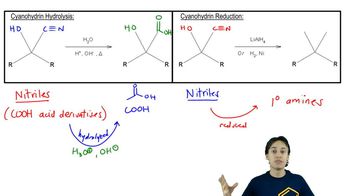
Cyanohydrin formation is a reaction where an aldehyde or ketone reacts with hydrogen cyanide (HCN) to form a cyanohydrin. In this process, the carbonyl carbon of the aldehyde or ketone is attacked by the cyanide ion, resulting in the addition of a cyano group and a hydroxyl group. This reaction is crucial for extending carbon chains in organic synthesis.
Recommended video:
Guided course
02:36
Nitrile Reduction

Nucleophilic Addition Reaction

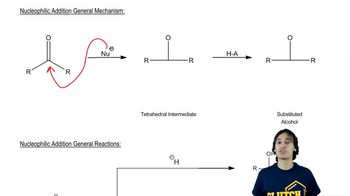
Nucleophilic addition is a fundamental reaction mechanism in organic chemistry where a nucleophile forms a bond with an electrophilic carbon atom, typically in a carbonyl group. In the context of cyanohydrin formation, the cyanide ion acts as the nucleophile, attacking the electrophilic carbon of the aldehyde, leading to the formation of a new carbon-carbon bond.
Recommended video:
Guided course
08:27
Nucleophilic Addition

Stereochemistry in Reactions

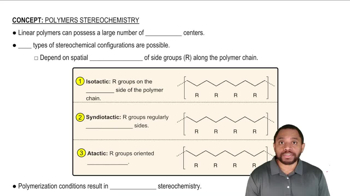
Stereochemistry involves the study of the spatial arrangement of atoms in molecules and its impact on chemical reactions. In reactions like cyanohydrin formation, the stereochemistry of the starting material can influence the configuration of the product. Understanding stereochemistry is essential for predicting the outcome of reactions involving chiral centers, such as those in monosaccharides.
Recommended video:
1:38
Polymer Stereochemistry Concept 1