Textbook Question
Show that the [4 + 4] cycloaddition of two butadiene molecules to give cycloocta-1,5-diene is thermally forbidden but photochemically allowed.
2
views

 Wade 9th EditionCh. 15 - Conjugated Systems, Orbital Symmetry, and Ultraviolet SpectroscopyProblem 22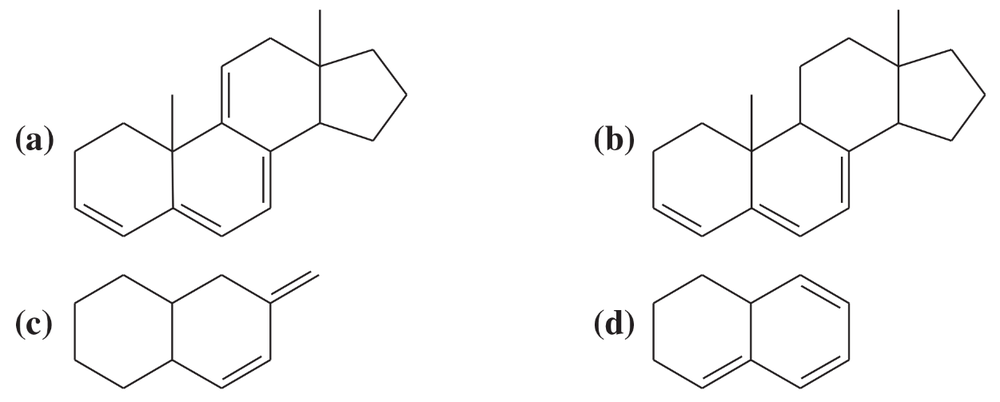
 Verified step by step guidance
 2:56
2:56
 03:27
03:27 4:47
4:47Show that the [4 + 4] cycloaddition of two butadiene molecules to give cycloocta-1,5-diene is thermally forbidden but photochemically allowed.
There is a different, thermally allowed cycloaddition of two butadiene molecules. Show this reaction, and explain why it is thermally allowed. (Hint: Consider the dimerization of cyclopentadiene.)
Phenolphthalein is an acid–base indicator that is colorless below pH 8 and red above pH 8. Explain briefly why the first structure is colorless and the second structure is colored.
One milligram of a compound of molecular weight 160 is dissolved in 10 mL of ethanol, and the solution is poured into a 1-cm UV cell. The UV spectrum is taken, and there is an absorption at λmax = 247 nm. The maximum absorbance at 247 nm is 0.50. Calculate the value of e for this absorption.
Classify the following dienes and polyenes as isolated, conjugated, cumulated, or some combination of these classifications.
(a) cycloocta-1,4-diene
(b) cycloocta-1,3-diene
(c) cyclodeca-1,2-diene
(d) cycloocta-1,3,5,7-tetraene
(e) cyclohexa-1,3,5-triene (benzene)
(f) penta-1,2,4-triene
Predict the products of the following reactions.
(a) allyl bromide + cyclohexyl magnesium bromide