Predict the product of the following sigmatropic rearrangements. Be sure to rationalize the stereochemical outcome with a chair-like transition state. (b)
Verified step by step guidance
1
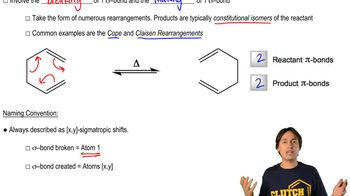
Identify the type of sigmatropic rearrangement involved. Sigmatropic rearrangements are classified by the number of atoms involved in the shift. For example, a [3,3]-sigmatropic rearrangement involves a shift of three atoms from each side of the breaking and forming bonds.
Draw the initial structure and identify the bonds that will break and form during the rearrangement. This will help visualize the movement of atoms and electrons.
Consider the stereochemistry of the transition state. Sigmatropic rearrangements often proceed through a chair-like transition state, especially in cyclic systems. Draw the chair conformation and place substituents accordingly to minimize steric hindrance and maximize stability.
Analyze the stereochemical outcome based on the transition state. The chair-like transition state can dictate the stereochemistry of the product due to the spatial arrangement of substituents. Ensure that the substituents are positioned to avoid 1,3-diaxial interactions, which are less stable.
Predict the final product structure, taking into account the stereochemical preferences observed in the transition state. Ensure that the product reflects the correct connectivity and stereochemistry as dictated by the rearrangement process.
Verified video answer for a similar problem:
This video solution was recommended by our tutors as helpful for the problem above
Video duration:
4m
Play a video:
0 Comments
Key Concepts
Here are the essential concepts you must grasp in order to answer the question correctly.
Sigmatropic Rearrangements
Sigmatropic rearrangements are a type of pericyclic reaction where a sigma bond adjacent to one or more pi systems migrates across the molecule. These reactions are characterized by the conservation of the total number of pi and sigma bonds and often involve a cyclic transition state. Understanding the specific type of sigmatropic shift, such as [1,5] or [3,3], is crucial for predicting the product.
A chair-like transition state is a conformation that resembles the chair form of cyclohexane, often adopted in pericyclic reactions to minimize steric strain and maximize orbital overlap. This conformation is particularly relevant in sigmatropic rearrangements as it helps rationalize the stereochemical outcome by providing a predictable spatial arrangement of substituents, leading to specific stereoisomers.
Stereochemistry in pericyclic reactions is governed by the conservation of orbital symmetry, as described by the Woodward-Hoffmann rules. These rules predict whether a reaction will proceed via a suprafacial or antarafacial pathway, influencing the stereochemical configuration of the product. In sigmatropic rearrangements, the stereochemical outcome is often determined by the geometry of the transition state, such as a chair-like conformation.