Ch. 21 - Carboxylic Acid Derivatives
Wade - Organic Chemistry 9th Edition
Wade9th EditionOrganic ChemistryISBN: 9780135213728Not the one you use?Change textbook
Chapter 21, Problem 57c

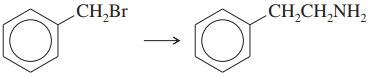
Show how you would accomplish the following multistep syntheses, using the indicated starting material and any necessary reagents.
(c) Chemical reaction showing the conversion of bromomethylbenzene to ethylamine-substituted benzene.

Verified step by step guidance
1
Step 1: Analyze the target molecule and the starting material. Identify the functional groups present in both and determine the transformations needed to convert the starting material into the target molecule.
Step 2: Plan the synthesis by identifying key reactions that can achieve the necessary transformations. Consider reactions such as oxidation, reduction, substitution, or addition, depending on the functional groups involved.
Step 3: Select appropriate reagents for each reaction step. For example, if an oxidation is required, you might choose reagents like PCC (Pyridinium chlorochromate) or KMnO4. If a reduction is needed, consider using reagents like LiAlH4 or NaBH4.
Step 4: Sequence the reactions logically, ensuring that each step is feasible and that the intermediate products are stable and can be isolated if necessary. Consider the order of reactions to avoid unwanted side reactions or degradation of the product.
Step 5: Write out the complete reaction mechanism for each step, showing how the starting material is transformed into the intermediate products and finally into the target molecule. Use curved arrows to indicate electron movement and ensure that all stereochemistry is correctly represented.

Verified video answer for a similar problem:

This video solution was recommended by our tutors as helpful for the problem above.
Video duration:
1m
Was this helpful?

Key Concepts

Here are the essential concepts you must grasp in order to answer the question correctly.

Multistep Synthesis

Multistep synthesis involves a series of chemical reactions that transform a starting material into a desired product through intermediate compounds. Understanding the sequence of reactions, including the reagents and conditions required for each step, is crucial for successfully completing the synthesis. This concept emphasizes the importance of planning and predicting the outcomes of each reaction to achieve the final product efficiently.
Recommended video:
Guided course
02:15
Multistep Synthesis

Reagents and Reaction Conditions

Reagents are substances used to bring about a chemical reaction, while reaction conditions refer to the specific environment (temperature, pressure, solvent, etc.) under which the reaction occurs. Knowledge of the appropriate reagents and conditions is essential for facilitating the desired transformations in a multistep synthesis. Selecting the right reagents can influence the yield and purity of the final product.
Recommended video:

Functional Group Transformations

Functional group transformations are chemical reactions that convert one functional group into another, which is a key aspect of organic synthesis. Understanding how different functional groups behave and react allows chemists to strategically modify molecules during synthesis. This concept is vital for predicting the outcomes of reactions and for designing pathways to synthesize complex organic compounds.
Recommended video:
Guided course
02:36
Identifying Functional Groups
Related Practice