
Ch. 21 - Carboxylic Acid Derivatives
Wade - Organic Chemistry 9th Edition
Wade9th EditionOrganic ChemistryISBN: 9780135213728Not the one you use?Change textbook
Chapter 21, Problem 55c2

Grignard reagents add to carbonate esters as they add to other esters.
(c) Diethyl carbonate is a liquid reagent that is easy to handle. Also show how you might use diethyl carbonate instead of methyl isocyanate to make Sevin® insecticide.

Verified step by step guidance
1
Understand the structure of diethyl carbonate (C5H10O3) and methyl isocyanate (CH3NCO). Diethyl carbonate contains two ethoxy groups (-OCH2CH3) attached to a central carbonyl group (C=O), while methyl isocyanate contains a methyl group (CH3) attached to an isocyanate functional group (-N=C=O).
Recall the structure of Sevin® insecticide, which is carbaryl (1-naphthyl N-methylcarbamate). It is synthesized by introducing a carbamate functional group (-NHCOO-) to a naphthol derivative. The goal is to replace methyl isocyanate with diethyl carbonate in this synthesis.
Propose a reaction mechanism where diethyl carbonate reacts with 1-naphthol (C10H7OH). The hydroxyl group (-OH) of 1-naphthol can act as a nucleophile, attacking the carbonyl carbon of diethyl carbonate, leading to the formation of an intermediate.
Account for the elimination of ethanol (C2H5OH) during the reaction. This occurs as the ethoxy group (-OCH2CH3) is displaced, leaving behind the desired carbamate functional group attached to the naphthol ring.
Verify the final product structure to ensure it matches the structure of Sevin® (1-naphthyl N-methylcarbamate). The reaction should yield the carbamate derivative of 1-naphthol, completing the synthesis using diethyl carbonate as a substitute for methyl isocyanate.

Verified video answer for a similar problem:

This video solution was recommended by our tutors as helpful for the problem above.
Video duration:
7m
Was this helpful?

Key Concepts

Here are the essential concepts you must grasp in order to answer the question correctly.

Diethyl Carbonate

Diethyl carbonate is an organic compound classified as a carbonate ester. It is a colorless, flammable liquid with a fruity odor, commonly used as a solvent and reagent in organic synthesis. Its structure allows it to participate in nucleophilic substitution reactions, making it a versatile building block in the synthesis of various organic compounds, including pharmaceuticals and agrochemicals.
Recommended video:
Guided course
02:12
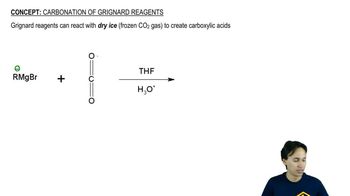
Carbonation of Grignard Reagents

Methyl Isocyanate

Methyl isocyanate (MIC) is a highly reactive organic compound known for its use in the production of pesticides, particularly carbamate insecticides like Sevin®. It is a toxic and volatile compound that can pose significant health risks. Understanding its reactivity and the mechanisms of its reactions is crucial for safely substituting it with less hazardous alternatives like diethyl carbonate in synthetic pathways.
Recommended video:
1:14
Step-Growth Polymers: Urethane Example 1

Carbamate Insecticides

Carbamate insecticides are a class of chemicals derived from carbamic acid, known for their effectiveness in pest control. They work by inhibiting the enzyme acetylcholinesterase, leading to the accumulation of acetylcholine and resulting in paralysis of the target pests. Understanding the synthesis and action of carbamates is essential for developing safer alternatives and improving the environmental profile of insecticides.
Recommended video:
1:38
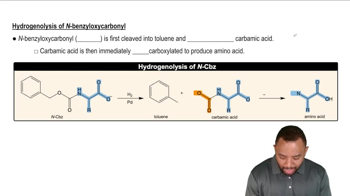
Reactions of Amino Acids: Hydrogenolysis Concept 2
Related Practice
Textbook Question

Grignard reagents add to carbonate esters as they add to other esters.

(a) Predict the major product of the following reaction.

(b) Show how you would synthesize 3-ethylpentan-3-ol using diethyl carbonate and ethyl bromide as your only organic reagents

2
views
Textbook Question

Show how you would accomplish the following multistep syntheses, using the indicated starting material and any necessary reagents.

(c)

1
views
Textbook Question

Show how you would accomplish the following multistep syntheses, using the indicated starting material and any necessary reagents.

(a) hept-6-en-1-ol → ε-caprolactone

(b) methoxybenzene → p-methoxybenzamide

2
views
Textbook Question

One mole of acetyl chloride is added to a liter of triethylamine, resulting in a vigorous exothermic reaction. Once the reaction mixture has cooled, 1 mole of ethanol is added. Another vigorous exothermic reaction results. The mixture is analyzed and found to contain triethylamine, ethyl acetate, and triethylammonium chloride. Propose mechanisms for the two exothermic reactions.

1
views
Textbook Question

Show how you would accomplish the following syntheses. Some of these conversions may require more than one step.

(e) cyclohexylamine → N-cyclohexylacetamide

(f) bromocyclohexane → dicyclohexylmethanol

Textbook Question

Grignard reagents add to carbonate esters as they add to other esters.

(c) Diethyl carbonate is a liquid reagent that is easy to handle. In contrast, phosgene is a highly toxic and corrosive gas. Show how you might use diethyl carbonate instead of phosgene to make Lexan®.

1
views