Ch. 21 - Carboxylic Acid Derivatives
Wade - Organic Chemistry 9th Edition
Wade9th EditionOrganic ChemistryISBN: 9780135213728Not the one you use?Change textbook
Chapter 21, Problem 55a,b

Grignard reagents add to carbonate esters as they add to other esters.
(a) Predict the major product of the following reaction.

(b) Show how you would synthesize 3-ethylpentan-3-ol using diethyl carbonate and ethyl bromide as your only organic reagents

Verified step by step guidance
1
Step 1: Understand the reactivity of Grignard reagents. Grignard reagents (R-MgX) are nucleophiles that react with carbonyl compounds. When reacting with esters, they add twice to form tertiary alcohols. In this case, diethyl carbonate (a carbonate ester) will react similarly, undergoing two nucleophilic additions.
Step 2: Write the reaction mechanism for part (a). The Grignard reagent (ethylmagnesium bromide, CH₃CH₂MgBr) will first attack one of the carbonyl groups in diethyl carbonate, forming a tetrahedral intermediate. This intermediate will collapse, expelling an ethoxide ion (CH₃CH₂O⁻) and forming an ethyl ketone intermediate (ethyl ethanoate). A second equivalent of the Grignard reagent will then attack the ketone, forming another tetrahedral intermediate, which upon protonation yields the tertiary alcohol.
Step 3: Predict the major product for part (a). The major product will be 3-ethylpentan-3-ol, a tertiary alcohol, formed after the two nucleophilic additions of ethylmagnesium bromide to diethyl carbonate followed by protonation.
Step 4: For part (b), plan the synthesis of 3-ethylpentan-3-ol. Start with diethyl carbonate (CO(OCH₂CH₃)₂) and ethyl bromide (CH₃CH₂Br). First, prepare the Grignard reagent by reacting ethyl bromide with magnesium in dry ether to form ethylmagnesium bromide. Then, react this Grignard reagent with diethyl carbonate in a 2:1 molar ratio to ensure two equivalents of the Grignard reagent are available for the double addition.
Step 5: Complete the synthesis by protonating the final product. After the reaction of ethylmagnesium bromide with diethyl carbonate, the reaction mixture is typically quenched with a dilute acid (e.g., HCl or H₂O) to protonate the alkoxide intermediate, yielding the desired tertiary alcohol, 3-ethylpentan-3-ol.

Verified video answer for a similar problem:

This video solution was recommended by our tutors as helpful for the problem above.
Video duration:
10m
Was this helpful?

Key Concepts

Here are the essential concepts you must grasp in order to answer the question correctly.

Grignard Reagents

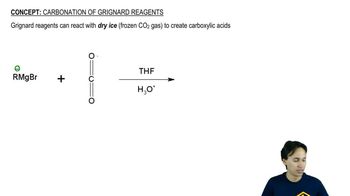
Grignard reagents are organomagnesium compounds that act as nucleophiles in organic reactions. They are formed by reacting an alkyl or aryl halide with magnesium metal in an anhydrous ether solvent. These reagents can add to carbonyl compounds, including esters and carbonates, leading to the formation of alcohols after hydrolysis. Understanding their reactivity is crucial for predicting the products of reactions involving carbonyl-containing compounds.
Recommended video:
Guided course
02:12
Carbonation of Grignard Reagents

Carbonate Esters

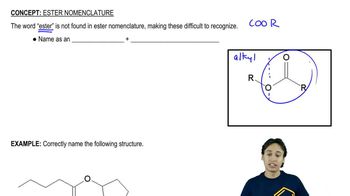
Carbonate esters are a class of compounds characterized by the presence of a carbonate functional group (–O–C(=O)–O–). They can undergo nucleophilic acyl substitution reactions, similar to regular esters, where a nucleophile attacks the carbonyl carbon. In the context of Grignard reagents, the addition to carbonate esters results in the formation of a new carbon-carbon bond, which is essential for synthesizing larger alcohols or other products.
Recommended video:
Guided course
02:39
Ester Nomenclature

Synthesis of Alcohols

The synthesis of alcohols from carbonyl compounds typically involves nucleophilic addition followed by hydrolysis. In this case, the reaction of a Grignard reagent with diethyl carbonate leads to the formation of a tertiary alcohol after the intermediate is hydrolyzed. Understanding the mechanism of this reaction is vital for predicting the structure of the final product, such as 3-ethylpentan-3-ol, and for planning synthetic routes in organic chemistry.
Recommended video:
Guided course
02:26
Forming alcohols through Oxymercuration-Reduction.
Related Practice
Textbook Question

Show how you would accomplish the following syntheses. Some of these conversions may require more than one step.

(d) ethyl acetate → 3-methylpentan-3-ol

5
views

Textbook Question

Show how you would accomplish the following syntheses. Some of these conversions may require more than one step.

(c) isobutylamine → N-isobutylformamide

1
views
Textbook Question

Grignard reagents add to carbonate esters as they add to other esters.

(c) Diethyl carbonate is a liquid reagent that is easy to handle. Also show how you might use diethyl carbonate instead of methyl isocyanate to make Sevin® insecticide.

2
views
Textbook Question

One mole of acetyl chloride is added to a liter of triethylamine, resulting in a vigorous exothermic reaction. Once the reaction mixture has cooled, 1 mole of ethanol is added. Another vigorous exothermic reaction results. The mixture is analyzed and found to contain triethylamine, ethyl acetate, and triethylammonium chloride. Propose mechanisms for the two exothermic reactions.

1
views
Textbook Question

Show how you would accomplish the following syntheses. Some of these conversions may require more than one step.

(e) cyclohexylamine → N-cyclohexylacetamide

(f) bromocyclohexane → dicyclohexylmethanol

Textbook Question

Grignard reagents add to carbonate esters as they add to other esters.

(c) Diethyl carbonate is a liquid reagent that is easy to handle. In contrast, phosgene is a highly toxic and corrosive gas. Show how you might use diethyl carbonate instead of phosgene to make Lexan®.

1
views