Ch. 9 - Substitution and Elimination Reactions of Alkyl Halides
Bruice - Organic Chemistry 8th Edition
Bruice8th EditionOrganic ChemistryISBN: 9780135213711Not the one you use?Change textbook
Chapter 10, Problem 123

The reaction of an alkyl chloride with potassium iodide is generally carried out in acetone to maximize the amount of alkyl iodide that is formed. Why does the solvent increase the yield of alkyl iodide? (Hint: Potassium iodide is soluble in acetone, but potassium chloride is not.)

Verified step by step guidance
1
Understand the reaction: The reaction involves the substitution of the chloride ion (Cl⁻) in the alkyl chloride with the iodide ion (I⁻) from potassium iodide (KI), forming alkyl iodide and potassium chloride (KCl). This is a nucleophilic substitution reaction.
Recognize the role of the solvent: Acetone is a polar aprotic solvent, meaning it does not have hydrogen atoms bonded to electronegative atoms like oxygen or nitrogen. Such solvents do not solvate anions (like I⁻) strongly, allowing the iodide ion to remain reactive and act as a strong nucleophile.
Consider the solubility of the reactants and products: Potassium iodide (KI) is soluble in acetone, so it dissociates into K⁺ and I⁻ ions. However, potassium chloride (KCl), the byproduct of the reaction, is not soluble in acetone and precipitates out of the solution.
Apply Le Chatelier's Principle: The precipitation of KCl removes it from the reaction mixture, shifting the equilibrium toward the formation of more alkyl iodide. This increases the yield of the desired product.
Conclude the solvent's effect: Acetone enhances the reaction by keeping the iodide ion reactive and by driving the reaction forward through the precipitation of KCl, thereby maximizing the yield of alkyl iodide.

Verified video answer for a similar problem:

This video solution was recommended by our tutors as helpful for the problem above.
Video duration:
4m
Was this helpful?

Key Concepts

Here are the essential concepts you must grasp in order to answer the question correctly.

Solubility and Reaction Dynamics

The solubility of reactants in a solvent significantly influences the reaction dynamics. In this case, potassium iodide (KI) is soluble in acetone, allowing it to dissociate into potassium (K+) and iodide (I-) ions. This increases the availability of iodide ions, which are crucial for the nucleophilic substitution reaction with alkyl chloride, thereby enhancing the formation of alkyl iodide.
Recommended video:
Guided course
02:01
Introducing common solvents and other molecules in organic chemistry.

Nucleophilic Substitution Mechanism

The reaction between alkyl chloride and potassium iodide typically follows a nucleophilic substitution mechanism, often SN2. In this mechanism, the iodide ion acts as a nucleophile, attacking the electrophilic carbon of the alkyl chloride, leading to the displacement of the chloride ion. The efficiency of this reaction is influenced by the concentration of the nucleophile, which is increased in acetone due to the solubility of KI.
Recommended video:
Guided course
01:47
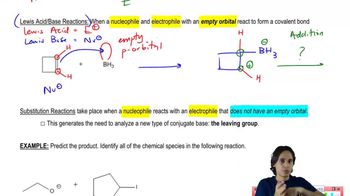
Nucleophiles and Electrophiles can react in Substitution Reactions.

Precipitation and Reaction Equilibrium

In a reaction where one product is insoluble, such as potassium chloride (KCl) in acetone, its precipitation drives the reaction equilibrium towards the formation of more alkyl iodide. According to Le Chatelier's principle, removing a product from the solution (in this case, KCl) shifts the equilibrium to favor the production of the desired product, thus increasing the overall yield of alkyl iodide.
Recommended video:
Guided course
04:00
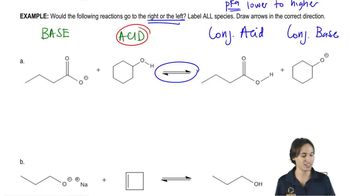
Determining Acid/Base Equilibrium