
The reaction of an alkyl chloride with potassium iodide is generally carried out in acetone to maximize the amount of alkyl iodide that is formed. Why does the solvent increase the yield of alkyl iodide? (Hint: Potassium iodide is soluble in acetone, but potassium chloride is not.)
Ch. 9 - Substitution and Elimination Reactions of Alkyl Halides
All textbooks
Bruice 8th Edition
Ch. 9 - Substitution and Elimination Reactions of Alkyl Halides
Problem 126
Bruice 8th Edition
Ch. 9 - Substitution and Elimination Reactions of Alkyl Halides
Problem 126Chapter 10, Problem 126
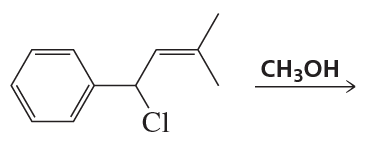
Predict the product for the following reaction and write a mechanism to explain how it is formed.

Verified step by step guidance1
Step 1: Analyze the reactants and reaction conditions. The reactant is an allylic bromide (a bromine atom attached to a carbon adjacent to a double bond). The solvent is methanol (CH₃OH), which can act as a nucleophile.
Step 2: Recognize the reaction type. This is likely an SN1 reaction due to the allylic bromide's ability to form a stable carbocation intermediate. Allylic carbocations are stabilized by resonance, making the SN1 pathway favorable.
Step 3: Write the first step of the mechanism. The bromine atom leaves, forming an allylic carbocation. This carbocation is stabilized by resonance, meaning the positive charge is delocalized over the π system of the double bonds.
Step 4: Identify the nucleophile's role. Methanol (CH₃OH) acts as the nucleophile and attacks the carbocation at the positively charged carbon. This results in the formation of a new bond between the carbon and the oxygen atom of methanol.
Step 5: Complete the mechanism. After the nucleophilic attack, a proton from the methanol group is removed by a base (possibly another methanol molecule), resulting in the final product: an ether with the methoxy group (-OCH₃) attached to the allylic position.

Verified video answer for a similar problem:
This video solution was recommended by our tutors as helpful for the problem above.
Video duration:
3mWas this helpful?
Key Concepts
Here are the essential concepts you must grasp in order to answer the question correctly.
Nucleophilic Substitution Reactions
Nucleophilic substitution reactions involve the replacement of a leaving group (like Br) by a nucleophile (like CH3OH). In these reactions, the nucleophile donates a pair of electrons to form a new bond, while the leaving group departs with its electrons. The two main types are SN1, which involves a two-step mechanism with a carbocation intermediate, and SN2, which is a one-step mechanism where the nucleophile attacks the substrate simultaneously as the leaving group departs.
Recommended video:
Guided course
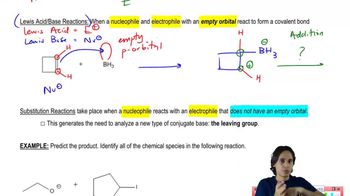
Nucleophiles and Electrophiles can react in Substitution Reactions.
Carbocation Stability
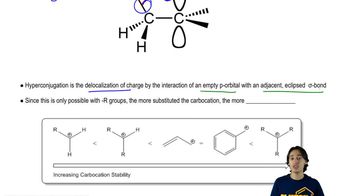
Carbocation stability is crucial in predicting the outcome of nucleophilic substitution reactions, particularly in SN1 mechanisms. Carbocations are positively charged species that can be stabilized by adjacent alkyl groups through hyperconjugation and inductive effects. The more substituted the carbocation (tertiary > secondary > primary), the more stable it is, influencing the likelihood of the reaction pathway taken.
Recommended video:
Guided course
Determining Carbocation Stability
Mechanism of SN1 Reactions
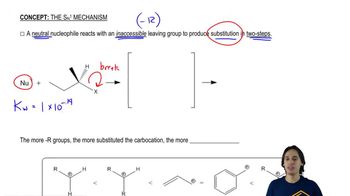
The mechanism of SN1 reactions consists of two main steps: formation of a carbocation intermediate and nucleophilic attack. Initially, the leaving group departs, forming a carbocation. This is followed by the nucleophile attacking the carbocation to form the final product. The rate of the reaction depends only on the concentration of the substrate, making it a unimolecular process, which is characteristic of SN1 reactions.
Recommended video:
Guided course
Drawing the SN1 Mechanism
Related Practice
Textbook Question
2
views
Textbook Question
When equivalent amounts of methyl bromide and sodium iodide are dissolved in methanol, the concentration of iodide ion quickly decreases and then slowly returns to its original concentration. Account for this observation.
2
views
Textbook Question
For each of the following compounds, draw the product that forms in an E2 reaction and indicate its configuration:
a. (1S,2S)-1-bromo-1,2-diphenylpropane
1
views
Textbook Question
What products are formed when the following stereoisomer of 2-chloro-1,3-dimethylcyclohexane reacts with methoxide ion?
2
views
Textbook Question
Propose a mechanism for the following reaction.
1
views
Textbook Question
For each of the following compounds, draw the product that forms in an E2 reaction and indicate its configuration:
b. (1S,2R)-1-bromo-1,2-diphenylpropane
1
views