When equivalent amounts of methyl bromide and sodium iodide are dissolved in methanol, the concentration of iodide ion quickly decreases and then slowly returns to its original concentration. Account for this observation.
Ch. 9 - Substitution and Elimination Reactions of Alkyl Halides
All textbooks
Bruice 8th Edition
Ch. 9 - Substitution and Elimination Reactions of Alkyl Halides
Problem 127a
Bruice 8th Edition
Ch. 9 - Substitution and Elimination Reactions of Alkyl Halides
Problem 127aChapter 10, Problem 127a
For each of the following compounds, draw the product that forms in an E2 reaction and indicate its configuration:
a. (1S,2S)-1-bromo-1,2-diphenylpropane
Verified step by step guidance1
Identify the substrate: The given compound is (1S,2S)-1-bromo-1,2-diphenylpropane. This is a secondary alkyl halide with a bromine atom attached to the first carbon and two phenyl groups attached to the first and second carbons.
Determine the mechanism: The problem specifies an E2 reaction. E2 (bimolecular elimination) reactions occur in a single concerted step, where a base abstracts a proton from a β-carbon (a carbon adjacent to the carbon bearing the leaving group), and the leaving group departs simultaneously, forming a double bond.
Analyze the stereochemistry: In an E2 reaction, the β-hydrogen and the leaving group (bromine in this case) must be antiperiplanar (in opposite planes and 180° apart) for the elimination to occur. Check the Newman projection or the 3D structure of the molecule to identify the antiperiplanar β-hydrogen.
Determine the product: Once the antiperiplanar β-hydrogen is identified, the base will abstract this proton, and the bromine will leave, forming a double bond between the α-carbon (carbon 1) and the β-carbon (carbon 2). The configuration of the product will depend on the stereochemistry of the starting material and the antiperiplanar geometry.
Indicate the configuration of the product: After forming the double bond, determine whether the product has an E (trans) or Z (cis) configuration based on the priority of the substituents attached to the double-bonded carbons, following the Cahn-Ingold-Prelog priority rules.

Verified video answer for a similar problem:
This video solution was recommended by our tutors as helpful for the problem above.
Video duration:
11mWas this helpful?
Key Concepts
Here are the essential concepts you must grasp in order to answer the question correctly.
E2 Reaction Mechanism
The E2 (bimolecular elimination) reaction is a type of elimination reaction where a base removes a proton from a β-carbon while a leaving group departs from the α-carbon, resulting in the formation of a double bond. This reaction is characterized by a single concerted step, meaning that bond breaking and bond formation occur simultaneously. The stereochemistry of the reactants significantly influences the product configuration, often leading to the formation of alkenes with specific stereochemical arrangements.
Recommended video:
Guided course
Drawing the E2 Mechanism.
Stereochemistry and Configuration
Stereochemistry refers to the spatial arrangement of atoms in molecules and how this affects their chemical behavior. In the context of E2 reactions, the configuration of the starting material (R or S) can determine the stereochemical outcome of the product. The E2 mechanism typically favors the formation of the more stable alkene, which can be influenced by the relative positions of substituents on the double bond, leading to either cis or trans configurations.
Recommended video:
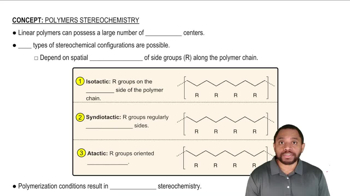
Polymer Stereochemistry Concept 1
Substituent Effects on Elimination Reactions
The presence and position of substituents on the carbon chain can significantly affect the outcome of E2 reactions. Bulky groups can hinder the approach of the base to the β-hydrogen, while the orientation of substituents can dictate whether the reaction proceeds via a syn or anti elimination pathway. Understanding these effects is crucial for predicting the major product and its configuration in elimination reactions, especially in complex molecules like diphenylpropane.
Recommended video:
Guided course
Intro to Substitution/Elimination Problems
Related Practice
Textbook Question
2
views
Textbook Question
What products are formed when the following stereoisomer of 2-chloro-1,3-dimethylcyclohexane reacts with methoxide ion?
2
views
Textbook Question
Propose a mechanism for the following reaction.
1
views
Textbook Question
Predict the product for the following reaction and write a mechanism to explain how it is formed.
1
views
Textbook Question
For each of the following compounds, draw the product that forms in an E2 reaction and indicate its configuration:
b. (1S,2R)-1-bromo-1,2-diphenylpropane
1
views
Textbook Question
Explain why the following alkyl halide does not undergo a substitution reaction, regardless of the base that is used.
1
views