Ch. 22 - Condensations and Alpha Substitutions of Carbonyl Compounds
Wade - Organic Chemistry 9th Edition
Wade9th EditionOrganic ChemistryISBN: 9780135213728Not the one you use?Change textbook
Chapter 22, Problem 69e

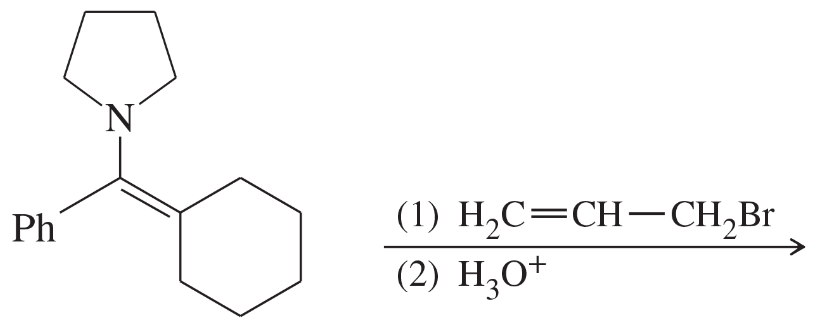
Predict the products of the following reactions.
(e)

Verified step by step guidance
1
Step 1: Analyze the starting material. The molecule contains a nitrogen atom in a pyrrolidine ring, which is nucleophilic due to the lone pair on nitrogen. Additionally, the molecule has a conjugated diene system with phenyl substituents.
Step 2: Examine the reagents. The first reagent is a phenyl-substituted allyl bromide (Ph-CH=CH-CH2Br), which is an electrophile due to the bromine atom. The second reagent is H3O+, which indicates acidic conditions.
Step 3: Predict the first step of the reaction. The nucleophilic nitrogen in the pyrrolidine ring will attack the electrophilic carbon in the allyl bromide, displacing the bromine atom via an SN2 mechanism. This forms a new bond between the nitrogen and the allyl group.
Step 4: Consider the role of H3O+. Under acidic conditions, the newly formed nitrogen-allyl bond may undergo protonation, leading to further rearrangements or stabilization of the product. Additionally, the conjugated diene system may remain intact or participate in further reactions depending on the conditions.
Step 5: Predict the final product. The reaction likely results in a nitrogen-substituted allyl compound, with the pyrrolidine ring intact and the conjugated diene system preserved. The exact structure depends on the stability of intermediates under acidic conditions.

Verified video answer for a similar problem:

This video solution was recommended by our tutors as helpful for the problem above.
Video duration:
3m
Was this helpful?

Key Concepts

Here are the essential concepts you must grasp in order to answer the question correctly.

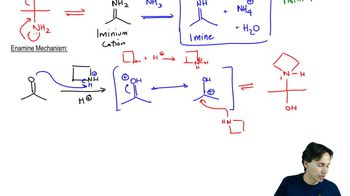
Enamines

Enamines are derivatives of imines, formed by the reaction of an aldehyde or ketone with a secondary amine. They contain a carbon-nitrogen double bond and are highly reactive intermediates in organic synthesis. Enamines can undergo nucleophilic addition reactions, making them useful for alkylation and acylation processes.
Recommended video:
Guided course
06:25
Enamine Mechanism

Alkylation

Alkylation is a chemical reaction that involves the transfer of an alkyl group from one molecule to another. In the context of enamines, alkylation typically occurs when the nucleophilic carbon of the enamine attacks an electrophile, such as an alkyl halide. This process is crucial for building complex organic molecules and expanding carbon chains.
Recommended video:
Guided course
03:19
Sodium Alkynide Alkylation

Acid-Catalyzed Hydrolysis

Acid-catalyzed hydrolysis is a reaction where water is used to break chemical bonds in the presence of an acid catalyst, often leading to the formation of alcohols or carbonyl compounds. In the case of enamines, treatment with an acid like H3O+ can convert the enamine back to the corresponding carbonyl compound, facilitating the synthesis of various functional groups.
Recommended video:
Guided course
03:09
Acid Catalyzed