Ch. 22 - Condensations and Alpha Substitutions of Carbonyl Compounds
Wade - Organic Chemistry 9th Edition
Wade9th EditionOrganic ChemistryISBN: 9780135213728Not the one you use?Change textbook
Chapter 22, Problem 69c

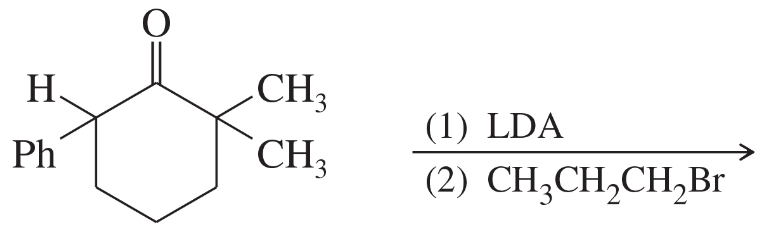
Predict the products of the following reactions.
(c)

Verified step by step guidance
1
Step 1: Identify the reagents and their roles. LDA (Lithium Diisopropylamide) is a strong, non-nucleophilic base commonly used to deprotonate alpha-hydrogens in carbonyl compounds, forming an enolate. The second reagent, ethyl bromide, is an alkyl halide that can participate in an alkylation reaction with the enolate.
Step 2: Locate the alpha-hydrogens in the molecule. Alpha-hydrogens are the hydrogens attached to the carbon atoms adjacent to the carbonyl group. In this case, the alpha-hydrogens are on the methyl group attached to the cyclopentenone ring.
Step 3: Deprotonation by LDA. LDA will selectively remove one of the alpha-hydrogens from the methyl group, forming a resonance-stabilized enolate. The enolate can be represented as a structure with a negative charge on the alpha-carbon and a double bond between the alpha-carbon and the carbonyl carbon.
Step 4: Reaction with ethyl bromide. The enolate acts as a nucleophile and attacks the electrophilic carbon in ethyl bromide, displacing the bromide ion. This results in the formation of a new carbon-carbon bond, adding an ethyl group to the alpha-carbon.
Step 5: Predict the final product. The product will be the original cyclopentenone structure with an ethyl group attached to the alpha-carbon of the methyl group. Ensure the stereochemistry and connectivity are consistent with the reaction mechanism.

Verified video answer for a similar problem:

This video solution was recommended by our tutors as helpful for the problem above.
Video duration:
4m
Was this helpful?

Key Concepts

Here are the essential concepts you must grasp in order to answer the question correctly.

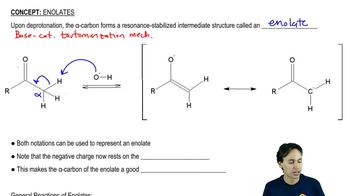
Enolate Formation

Enolates are formed when a base abstracts a proton from the alpha carbon of a carbonyl compound, resulting in a resonance-stabilized anion. In this reaction, LDA (Lithium diisopropylamide) acts as a strong base to deprotonate the carbonyl compound, generating the enolate. This enolate can then act as a nucleophile in subsequent reactions.
Recommended video:
Guided course
02:26
Formation of Enolates

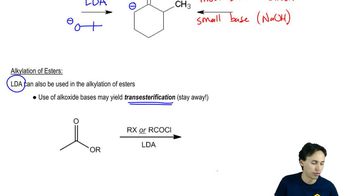
Alkylation of Enolates

Once formed, enolates can undergo alkylation, where they react with alkyl halides (like bromoalkanes) to form new carbon-carbon bonds. The nucleophilic enolate attacks the electrophilic carbon in the alkyl halide, leading to the substitution of the halide with the enolate. This process is crucial for building complex organic molecules.
Recommended video:
Guided course
03:05
Enolates of Esters

Regioselectivity in Alkylation

Regioselectivity refers to the preference of a chemical reaction to yield one structural isomer over others. In the case of enolate alkylation, the position at which the enolate attacks the alkyl halide can lead to different products depending on the stability of the resulting carbocation and steric factors. Understanding regioselectivity is essential for predicting the major product of the reaction.
Recommended video:
Guided course
03:19
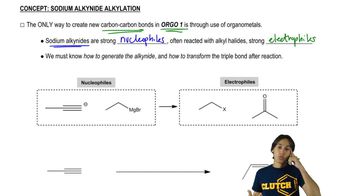
Sodium Alkynide Alkylation