Ch. 22 - Condensations and Alpha Substitutions of Carbonyl Compounds
Wade - Organic Chemistry 9th Edition
Wade9th EditionOrganic ChemistryISBN: 9780135213728Not the one you use?Change textbook
Chapter 22, Problem 69f

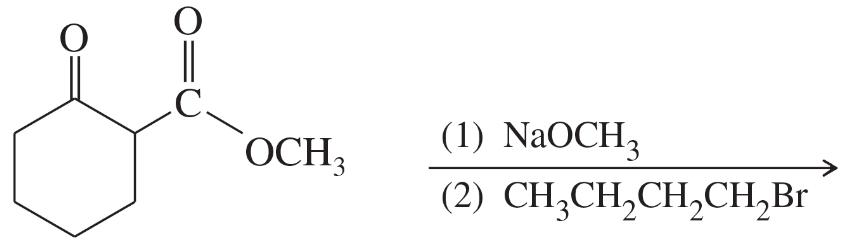
Predict the products of the following reactions.
(f)

Verified step by step guidance
1
Step 1: Analyze the starting material, which is a cyclic anhydride. Cyclic anhydrides are reactive compounds that can undergo nucleophilic attack at the carbonyl carbon.
Step 2: The first reagent, CH3ONa (sodium methoxide), acts as a nucleophile. It will attack one of the carbonyl carbons in the anhydride, leading to the opening of the ring and formation of a carboxylate group and an ester group.
Step 3: The second reagent, CH3CH2CH2Br (1-bromopropane), is an alkyl halide. It will react with the carboxylate group formed in the previous step via an SN2 mechanism, replacing the bromine atom with the alkyl group.
Step 4: The final product will consist of an ester group and a carboxylic acid derivative where the alkyl group from the alkyl halide has been added.
Step 5: Ensure stereochemistry and regiochemistry are considered, if applicable, during the SN2 reaction. The product will be a substituted ester and carboxylic acid derivative.

Verified video answer for a similar problem:

This video solution was recommended by our tutors as helpful for the problem above.
Video duration:
1m
Was this helpful?

Key Concepts

Here are the essential concepts you must grasp in order to answer the question correctly.

Beta-Dicarbonyl Compounds

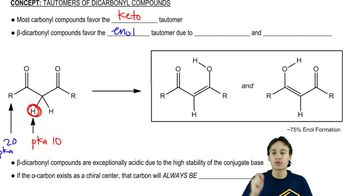
Beta-dicarbonyl compounds are organic molecules containing two carbonyl groups (C=O) separated by a single carbon atom. These compounds are important in organic synthesis due to their reactivity, particularly in nucleophilic addition reactions. The presence of two carbonyls enhances acidity and allows for enolate formation, which can be further reacted with alkyl halides to form larger carbon chains.
Recommended video:
Guided course
04:48
Tautomers of Dicarbonyls

Enolate Formation

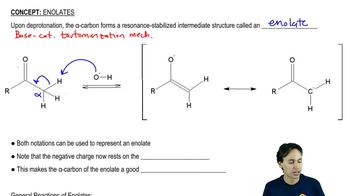
Enolate formation occurs when a base abstracts a proton from the alpha carbon of a carbonyl compound, resulting in a resonance-stabilized anion. In this reaction, CH3ONa acts as a strong base, deprotonating the beta-dicarbonyl compound to generate an enolate. This enolate can then act as a nucleophile, attacking an electrophile such as an alkyl halide, facilitating carbon chain elongation.
Recommended video:
Guided course
02:26
Formation of Enolates

Nucleophilic Substitution Reactions

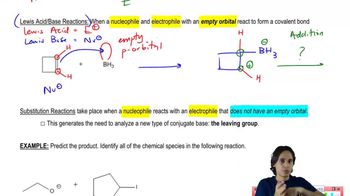
Nucleophilic substitution reactions involve the replacement of a leaving group in a molecule by a nucleophile. In this case, the enolate formed from the beta-dicarbonyl compound acts as the nucleophile, attacking the alkyl bromide. This reaction typically follows either an SN2 mechanism, where the nucleophile attacks the electrophile in a single step, or an SN1 mechanism, depending on the structure of the alkyl halide and reaction conditions.
Recommended video:
Guided course
01:47
Nucleophiles and Electrophiles can react in Substitution Reactions.