Table of contents
- 0. Basic Principles of Economics
- Introduction to Economics
- People Are Rational
- People Respond to Incentives
- Scarcity and Choice
- Marginal Analysis
- Allocative Efficiency, Productive Efficiency, and Equality
- Positive and Normative Analysis
- Microeconomics vs. Macroeconomics
- Factors of Production
- Circular Flow Diagram
- Graphing Review
- Percentage and Decimal Review
- Fractions Review
- 1. Reading and Understanding Graphs
- 2. Introductory Economic Models
- 3. The Market Forces of Supply and Demand
- Competitive Markets
- The Demand Curve
- Shifts in the Demand Curve
- Movement Along a Demand Curve
- The Supply Curve
- Shifts in the Supply Curve
- Movement Along a Supply Curve
- Market Equilibrium
- Using the Supply and Demand Curves to Find Equilibrium
- Effects of Surplus
- Effects of Shortage
- Supply and Demand: Quantitative Analysis
- 4. Elasticity
- Percentage Change and Price Elasticity of Demand
- Elasticity and the Midpoint Method
- Price Elasticity of Demand on a Graph
- Determinants of Price Elasticity of Demand
- Total Revenue Test
- Total Revenue Along a Linear Demand Curve
- Income Elasticity of Demand
- Cross-Price Elasticity of Demand
- Price Elasticity of Supply
- Price Elasticity of Supply on a Graph
- Elasticity Summary
- 5. Consumer and Producer Surplus; Price Ceilings and Floors
- Consumer Surplus and Willingness to Pay
- Producer Surplus and Willingness to Sell
- Economic Surplus and Efficiency
- Quantitative Analysis of Consumer and Producer Surplus at Equilibrium
- Price Ceilings, Price Floors, and Black Markets
- Quantitative Analysis of Price Ceilings and Price Floors: Finding Points
- Quantitative Analysis of Price Ceilings and Price Floors: Finding Areas
- 6. Introduction to Taxes and Subsidies
- 7. Externalities
- 8. The Types of Goods
- 9. International Trade
- 10. The Costs of Production
- 11. Perfect Competition
- Introduction to the Four Market Models
- Characteristics of Perfect Competition
- Revenue in Perfect Competition
- Perfect Competition Profit on the Graph
- Short Run Shutdown Decision
- Long Run Entry and Exit Decision
- Individual Supply Curve in the Short Run and Long Run
- Market Supply Curve in the Short Run and Long Run
- Long Run Equilibrium
- Perfect Competition and Efficiency
- Four Market Model Summary: Perfect Competition
- 12. Monopoly
- 13. Monopolistic Competition
- 14. Oligopoly
- 15. Markets for the Factors of Production
- 16. Income Inequality and Poverty
- 17. Asymmetric Information, Voting, and Public Choice
- 18. Consumer Choice and Behavioral Economics
17. Asymmetric Information, Voting, and Public Choice
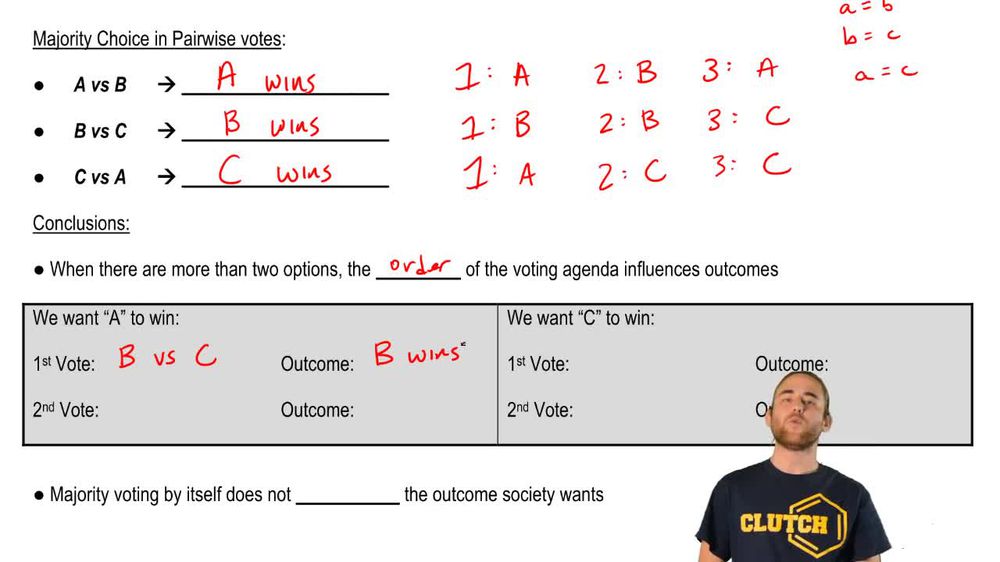
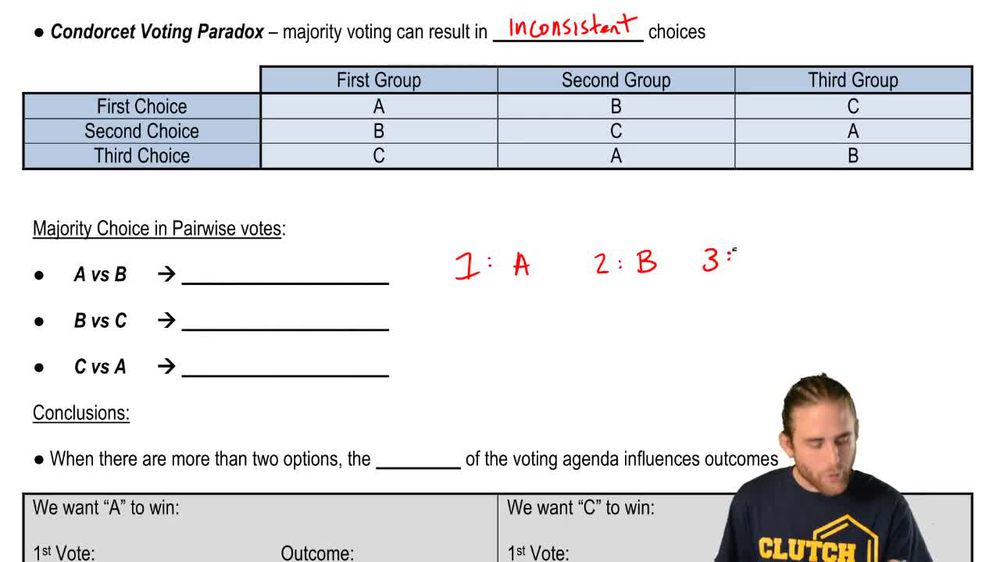
Condorcet Voting Paradox
 03:39
03:39