Ch. 3 - Observing Microorganisms Through a Microscope
Tortora - Microbiology: An Introduction 14th Edition
Tortora14th EditionMicrobiology: An IntroductionISBN: 9780138200398Not the one you use?Change textbook
Chapter 3, Problem 8

What is the purpose of a decolorizer in the Gram stain? In the acid-fast stain?

Verified step by step guidance
1
Understand that both the Gram stain and the acid-fast stain are differential staining techniques used to classify bacteria based on their cell wall properties.
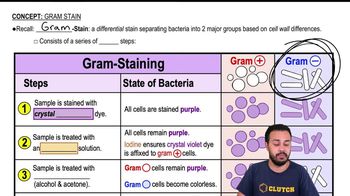
In the Gram stain, the decolorizer (usually alcohol or acetone-alcohol) is applied after the primary stain (crystal violet) and the mordant (iodine). Its purpose is to selectively remove the crystal violet-iodine complex from Gram-negative bacteria, which have a thinner peptidoglycan layer, while Gram-positive bacteria retain the stain due to their thicker peptidoglycan layer.
In the acid-fast stain, the decolorizer (usually acid-alcohol) is used after the primary stain (carbol fuchsin). Its role is to remove the stain from non–acid-fast bacteria, which lack the waxy mycolic acid in their cell walls, while acid-fast bacteria retain the stain because their cell walls resist decolorization.
Recognize that the decolorizer is a critical step in both stains because it differentiates bacteria based on their cell wall composition by selectively removing the primary stain from certain groups.
Summarize that the decolorizer's purpose is to act as a selective agent that differentiates bacterial types by their ability to retain or lose the primary stain during the staining process.

Verified video answer for a similar problem:

This video solution was recommended by our tutors as helpful for the problem above.
Video duration:
1m
Was this helpful?

Key Concepts

Here are the essential concepts you must grasp in order to answer the question correctly.

Gram Stain Procedure

The Gram stain is a differential staining technique used to classify bacteria into Gram-positive and Gram-negative based on their cell wall structure. It involves applying a primary stain, a mordant, a decolorizer, and a counterstain to distinguish bacterial types by color.
Recommended video:

Role of Decolorizer in Gram Stain

In the Gram stain, the decolorizer (usually alcohol or acetone-alcohol) selectively removes the primary stain from Gram-negative bacteria by dissolving their outer membrane and washing out the crystal violet-iodine complex. This step differentiates Gram-negative (colorless after decolorization) from Gram-positive bacteria (retain purple color).
Recommended video:

Decolorizer Function in Acid-Fast Stain

In the acid-fast stain, the decolorizer (acid-alcohol) removes the primary stain from non–acid-fast cells but not from acid-fast bacteria, which have waxy mycolic acid in their cell walls. This selective decolorization allows acid-fast bacteria to retain the red stain, distinguishing them from non–acid-fast cells.
Recommended video:
Guided course
05:30
Simple Staining Basic & Acidic Dyes