
Textbook Question
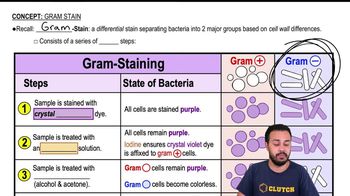
Why is a mordant used in the Gram stain? In the flagella stain?

 Verified step by step guidance

 02:10
02:10
 04:57
04:57 02:45
02:45Why is a mordant used in the Gram stain? In the flagella stain?
Which of the following pairs is mismatched?
a. Capsule—negative stain
b. Cell arrangement—simple stain
c. Cell size—negative stain
d. Gram stain—bacterial identification
e. None of the above
Assume that you are viewing a Gram-stained field of red cocci and blue rods through the microscope. You can safely conclude that you have
a. Made a mistake in staining
b. Two different species
c. Old bacterial cells
d. Young bacterial cells
e. None of the above
Which of the following is not a functionally analogous pair of stains?
a. Nigrosin and malachite green
b. Crystal violet and carbolfuchsin
c. Safranin and methylene blue
d. Ethanol-acetone and acid-alcohol
e. All of the above pairs are functionally analogous.
Assume you stain Clostridium by applying a basic stain, carbolfuchsin, with heat, decolorizing with acid-alcohol, and counterstaining with an acidic stain, nigrosin. Through the microscope, the endospores are 1, and the cells are stained 2.
a. 1—red; 2—black
b. 1—black; 2—colorless
c. 1—colorless; 2—black
d. 1—red; 2—colorless
e. 1—black; 2—red
What is the purpose of a decolorizer in the Gram stain? In the acid-fast stain?