Ch. 16 - Innate Immunity: Nonspecific Defenses of the Host
Tortora - Microbiology: An Introduction 14th Edition
Tortora14th EditionMicrobiology: An IntroductionISBN: 9780138200398Not the one you use?Change textbook
Chapter 16, Problem 9

Which of the following statements about IFN-α is false?
a. It interferes with viral replication.
b. It is host-cell–specific.
c. It is released by fibroblasts.
d. It is virus-specific.
e. It is released by lymphocytes.

Verified step by step guidance
1
Step 1: Understand what IFN- (Interferon) refers to in the context of microbiology. IFNs are proteins released by host cells in response to pathogens such as viruses, and they help interfere with viral replication.
Step 2: Review the general properties of interferons, especially focusing on their specificity. Interferons are generally not virus-specific but rather host-cell-specific, meaning they act on cells of the host organism rather than targeting specific viruses.
Step 3: Analyze each statement individually: (a) IFN interferes with viral replication — this is true as it helps inhibit virus multiplication; (b) IFN is host-cell–specific — this is true because it acts on host cells to induce antiviral states; (c) IFN is released by fibroblasts — this is true as fibroblasts can produce certain types of interferons; (d) IFN is virus-specific — this is likely false because interferons are not specific to particular viruses; (e) IFN is released by lymphocytes — this is true since lymphocytes, especially T cells, can produce interferons.
Step 4: Conclude that the false statement is the one claiming IFN is virus-specific, as interferons act broadly against viruses by inducing antiviral states in host cells rather than targeting specific viruses.
Step 5: Summarize that understanding the mechanism and source of interferons helps identify the incorrect statement by comparing each option to known biological facts about IFNs.

Verified video answer for a similar problem:

This video solution was recommended by our tutors as helpful for the problem above.
Video duration:
1m
Was this helpful?

Key Concepts

Here are the essential concepts you must grasp in order to answer the question correctly.

Interferon (IFN) Function

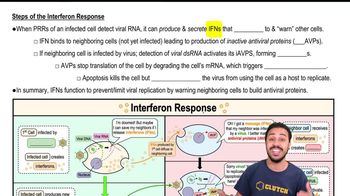
Interferons are proteins produced by host cells in response to viral infections. They help inhibit viral replication by interfering with the virus's ability to reproduce inside host cells, thus playing a crucial role in the innate immune response.
Recommended video:
Guided course
09:59
Steps of the Interferon Response

Host-Cell Specificity vs. Virus Specificity

Interferons are host-cell–specific, meaning they act on the cells of the organism producing them to induce antiviral states. However, they are not virus-specific; they do not target a particular virus but provide a broad antiviral effect against many viruses.
Recommended video:
Guided course
03:25
Water’s High Specific Heat

Sources of Interferon Production

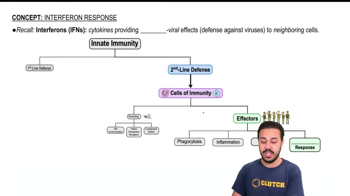
Different types of interferons are produced by various cells: fibroblasts primarily release type I interferons (like IFN-alpha), while lymphocytes (especially natural killer cells and T cells) produce other types. Understanding which cells produce IFN helps clarify their role in immune defense.
Recommended video:
Guided course
01:32
Interferon Response