Ch. 16 - Innate Immunity: Nonspecific Defenses of the Host
Tortora - Microbiology: An Introduction 14th Edition
Tortora14th EditionMicrobiology: An IntroductionISBN: 9780138200398Not the one you use?Change textbook
Chapter 16, Problem 9

Are the following involved in innate or in adaptive immunity? Identify the role of each in immunity:
a. TLRs
b. transferrins
c. antimicrobial peptides

Verified step by step guidance
1
Step 1: Understand the difference between innate and adaptive immunity. Innate immunity is the body's first line of defense, providing immediate but non-specific protection. Adaptive immunity is specific and develops over time, involving memory cells that respond to particular pathogens.
Step 2: Identify the role of TLRs (Toll-like receptors). TLRs are pattern recognition receptors that detect common molecular patterns on pathogens and activate immune responses quickly. Since they recognize general features and act immediately, they are part of innate immunity.
Step 3: Analyze transferrins. Transferrins are iron-binding proteins that limit the availability of free iron to microbes, inhibiting their growth. This mechanism is a non-specific defense and part of innate immunity.
Step 4: Examine antimicrobial peptides. These peptides directly kill or inhibit the growth of microbes by disrupting their membranes. Because they act rapidly and non-specifically, antimicrobial peptides are components of innate immunity.
Step 5: Summarize the roles: TLRs detect pathogens and trigger innate immune responses; transferrins sequester iron to prevent microbial growth; antimicrobial peptides directly attack microbes. All three are involved in innate immunity rather than adaptive immunity.

Verified video answer for a similar problem:

This video solution was recommended by our tutors as helpful for the problem above.
Video duration:
2m
Was this helpful?

Key Concepts

Here are the essential concepts you must grasp in order to answer the question correctly.

Innate Immunity

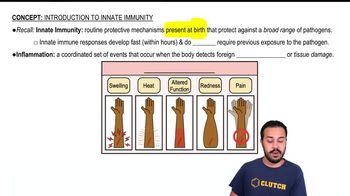
Innate immunity is the body's first line of defense against pathogens, providing immediate but non-specific protection. It involves physical barriers, immune cells, and molecules that recognize common microbial features. Components like Toll-like receptors (TLRs), transferrins, and antimicrobial peptides are key players in this system.
Recommended video:
Guided course
02:30
Introduction to Innate Immunity

Toll-like Receptors (TLRs)

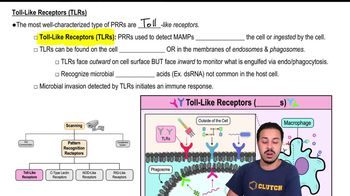
TLRs are pattern recognition receptors found on immune cells that detect conserved molecular patterns on pathogens. They trigger signaling pathways that activate innate immune responses, such as inflammation and cytokine production, helping to control infections early.
Recommended video:
Guided course
03:35
Toll-Like Receptors

Transferrins and Antimicrobial Peptides

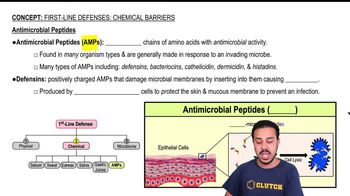
Transferrins are iron-binding proteins that limit microbial growth by sequestering iron, an essential nutrient for bacteria. Antimicrobial peptides are small molecules that directly kill or inhibit microbes by disrupting their membranes. Both contribute to innate immunity by preventing pathogen survival and proliferation.
Recommended video:
Guided course
02:43
Antimicrobial Peptides