Label on the figure the following processes that result in phagocytosis: margination, diapedesis, adherence, and phagolysosome formation.
Ch. 16 - Innate Immunity: Nonspecific Defenses of the Host

Tortora14th EditionMicrobiology: An IntroductionISBN: 9780138200398Not the one you use?Change textbook
All textbooks
Tortora 14th Edition
Ch. 16 - Innate Immunity: Nonspecific Defenses of the Host
Problem 8
Tortora 14th Edition
Ch. 16 - Innate Immunity: Nonspecific Defenses of the Host
Problem 8Chapter 16, Problem 8
Helicobacter pylori uses the enzyme urease to counteract a chemical defense in the human organ in which it lives. This chemical defense is
a. lysozyme.
b. hydrochloric acid.
c. superoxide radicals.
d. sebum.
e. complement.
Verified step by step guidance1
Step 1: Understand the habitat of Helicobacter pylori, which is the human stomach, an environment known for its highly acidic conditions.
Step 2: Recognize that Helicobacter pylori produces the enzyme urease, which catalyzes the hydrolysis of urea into ammonia and carbon dioxide.
Step 3: Connect the production of ammonia by urease to its role in neutralizing the acidic environment, thereby protecting the bacteria from stomach acid.
Step 4: Identify the chemical defense in the stomach that urease helps to counteract, which is the acidic pH primarily due to hydrochloric acid.
Step 5: Review the answer choices and select the one that corresponds to the stomach's chemical defense neutralized by urease, which is hydrochloric acid.

Verified video answer for a similar problem:
This video solution was recommended by our tutors as helpful for the problem above.
Video duration:
1mWas this helpful?
Key Concepts
Here are the essential concepts you must grasp in order to answer the question correctly.
Helicobacter pylori and its survival mechanism
Helicobacter pylori is a bacterium that colonizes the human stomach, an acidic environment hostile to most microbes. It produces the enzyme urease, which breaks down urea into ammonia and carbon dioxide, helping neutralize stomach acid and protect the bacterium from acidic damage.
Recommended video:
Guided course
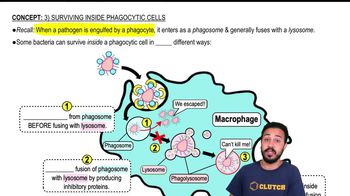
Surviving Inside Phagocytic Cells
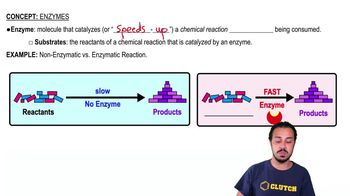
Role of urease enzyme
Urease catalyzes the hydrolysis of urea into ammonia and carbon dioxide. The ammonia raises the local pH around H. pylori, neutralizing the stomach's hydrochloric acid and allowing the bacterium to survive and colonize the gastric mucosa.
Recommended video:
Guided course
Enzymes
Chemical defenses of the stomach
The stomach defends against pathogens primarily through hydrochloric acid, which creates a highly acidic environment (pH ~1-2) that kills many microbes. Other defenses include enzymes and immune factors, but hydrochloric acid is the main chemical barrier targeted by H. pylori.
Recommended video:
Guided course

Chemical Defenses: Gastric Juice Prevents Microbial Growth by Lowering pH
Related Practice
Textbook Question
1
views
Textbook Question
Are the following involved in innate or in adaptive immunity? Identify the role of each in immunity:
a. TLRs
b. transferrins
c. antimicrobial peptides
1
views
Textbook Question
Which of the following does not stimulate phagocytes?
a. Cytokines
b. IFN-y
c. C3b
d. Lipid A
e. Histamine
1
views
Textbook Question
Give several examples of how microbes evade the complement system.
Textbook Question
In 1884, Elie Metchnikoff observed cells collected around a splinter inserted in a sea star embryo. This was the discovery of
a. blood cells.
b. sea stars.
c. phagocytosis.
d. immunity.
e. none of the above
6
views
Textbook Question
Which of the following statements about IFN-α is false?
a. It interferes with viral replication.
b. It is host-cell–specific.
c. It is released by fibroblasts.
d. It is virus-specific.
e. It is released by lymphocytes.
1
views