Ch. 3 - Cell Structure and Function
Bauman - Microbiology with Diseases by Taxonomy 6th Edition
Bauman6th EditionMicrobiology with Diseases by TaxonomyISBN: 9780134832302Not the one you use?Change textbook
Chapter 3, Problem 3.8a

Which of the following is not a function of a glycocalyx?


a. It forms pseudopods for faster mobility of an organism.
b. It can protect a bacterial cell from drying out.
c. It hides a bacterial cell from other cells.
d. It allows a bacterium to stick to a host.

Verified step by step guidance
1
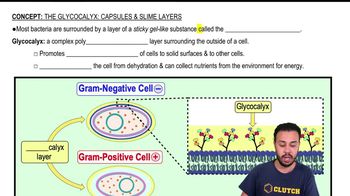
Understand what a glycocalyx is: a glycocalyx is a gelatinous, sticky substance that surrounds the outside of some bacterial cells.
Identify the functions of a glycocalyx: it helps in protection against desiccation, aids in adherence to surfaces, and can help evade the immune system by hiding the bacterial cell.
Analyze each option: a) forming pseudopods is not a typical function of a glycocalyx, b) protecting from drying out is a function, c) hiding from other cells is a function, d) sticking to a host is a function.
Recognize that pseudopods are extensions of the cell membrane used for movement, typically associated with eukaryotic cells, not a function of a glycocalyx.
Conclude that the option describing pseudopod formation is not a function of a glycocalyx.

Verified video answer for a similar problem:

This video solution was recommended by our tutors as helpful for the problem above.
Video duration:
2m
Was this helpful?

Key Concepts

Here are the essential concepts you must grasp in order to answer the question correctly.

Glycocalyx Structure

The glycocalyx is a sticky, gelatinous layer surrounding the cell wall of many bacteria, composed of polysaccharides and glycoproteins. It plays a crucial role in cell protection, adherence, and communication. Understanding its structure helps clarify its various functions, including how it aids in bacterial survival in hostile environments.
Recommended video:
Guided course
02:26
The Glycocalyx: Capsules & Slime Layers

Functions of Glycocalyx

The glycocalyx serves multiple functions, such as protecting bacteria from desiccation, facilitating adherence to surfaces, and evading the immune response. It can form biofilms, which are communities of microorganisms that adhere to surfaces, enhancing their survival and resistance to antibiotics. Recognizing these functions is essential for evaluating the options presented in the question.
Recommended video:
Guided course
02:26
The Glycocalyx: Capsules & Slime Layers

Pseudopods and Mobility

Pseudopods are temporary projections of eukaryotic cells, primarily involved in movement and feeding, particularly in amoebas. Bacteria do not utilize pseudopods for mobility; instead, they may use flagella or other structures. This distinction is critical for understanding why the statement regarding pseudopods is incorrect in the context of glycocalyx functions.
Recommended video:
Guided course
01:59
Genome Variability
Related Practice
Textbook Question

A "9 + 2" arrangement of microtubules is seen in __________ .


a. archaeal flagella

b. bacterial flagella

c. eukaryotic flagella

d. all prokaryotic flagella

1
views

Textbook Question

Define cytosol.

1
views
Textbook Question

A scientist who is studying passive movement of chemicals across the cytoplasmic membrane of Salmonella enterica serotype Typhi measures the rate at which two chemicals diffuse into a cell as a function of external concentration. The results are shown in the following figure. Chemical A diffuses into the cell more rapidly than does B at lower external concentrations, but the rate levels off as the external concentration increases. The rate of diffusion of chemical B continues to increase as the external concentration increases.


a. How can you explain the differences in the diffusion rates of chemicals A and B?

b. Why does the diffusion rate of chemical A taper off?

c. How could the cell increase the diffusion rate of chemical A?

d. How could the cell increase the diffusion rate of chemical B?

8
views
Textbook Question

Which of the following is most associated with diffusion?


a. Symports

b. Antiports

c. Carrier proteins

d. Endocytosis

1
views
Textbook Question

A local newspaper writer has contacted you, an educated microbiology student from a respected college. He wants to obtain scientific information for an article he is writing about “life” and poses the following query: “What is the difference between a living thing and a nonliving thing?” Knowing that he will edit your material to fit the article, give an intelligent, scientific response.

1
views
Textbook Question

The term fluid mosaic has been used in describing the cytoplasmic membrane. How does each word of that phrase accurately describe our current understanding of a cell membrane?