Ch. 3 - Cell Structure and Function
Bauman - Microbiology with Diseases by Taxonomy 6th Edition
Bauman6th EditionMicrobiology with Diseases by TaxonomyISBN: 9780134832302Not the one you use?Change textbook
Chapter 3, Problem 3

A "9 + 2" arrangement of microtubules is seen in __________ .


a. archaeal flagella
b. bacterial flagella
c. eukaryotic flagella
d. all prokaryotic flagella

Verified step by step guidance
1
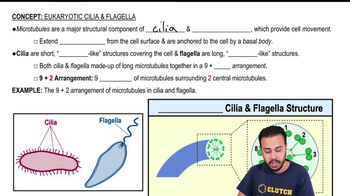
Understand that the '9 + 2' arrangement refers to the specific structural pattern of microtubules found in certain flagella or cilia, where 9 pairs of microtubules form a ring around 2 central single microtubules.
Recall that microtubules are components of the cytoskeleton made of tubulin proteins, and this '9 + 2' pattern is characteristic of eukaryotic cells, not prokaryotic cells.
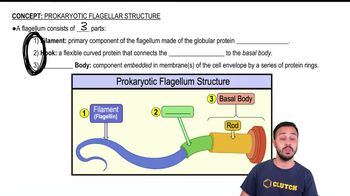
Recognize that prokaryotic flagella (found in bacteria and archaea) do not have microtubules; instead, they are composed of the protein flagellin and have a different structural organization.
Therefore, identify that the '9 + 2' microtubule arrangement is specifically seen in eukaryotic flagella and cilia, which are membrane-bound organelles.
Conclude that the correct answer corresponds to the option describing eukaryotic flagella.

Verified video answer for a similar problem:

This video solution was recommended by our tutors as helpful for the problem above.
Video duration:
2m
Was this helpful?

Key Concepts

Here are the essential concepts you must grasp in order to answer the question correctly.

Structure of Microtubules in Flagella

The '9 + 2' arrangement refers to a specific microtubule pattern found in the axoneme of eukaryotic flagella and cilia, consisting of nine doublet microtubules surrounding two central singlet microtubules. This structure is essential for the motility of eukaryotic cells.
Recommended video:
Guided course
02:53
Prokaryotic Flagellar Structure

Differences Between Prokaryotic and Eukaryotic Flagella

Prokaryotic flagella, found in bacteria and archaea, are structurally simpler and made of flagellin protein, lacking microtubules. In contrast, eukaryotic flagella have a complex internal structure with microtubules arranged in the '9 + 2' pattern, powered by dynein motor proteins.
Recommended video:
Guided course
02:07
Introduction to Prokaryotic Flagella

Function and Composition of Eukaryotic Flagella

Eukaryotic flagella are membrane-bound organelles that enable cell movement through coordinated bending of microtubules. Their '9 + 2' microtubule arrangement provides structural support and facilitates movement via ATP-driven dynein arms.
Recommended video:
Guided course
02:36
Eukaryotic Cilia & Flagella
Related Practice
Textbook Question

Which of the following is not a function of a glycocalyx?


a. It forms pseudopods for faster mobility of an organism.

b. It can protect a bacterial cell from drying out.

c. It hides a bacterial cell from other cells.

d. It allows a bacterium to stick to a host.

1
views
Textbook Question

Define cytosol.

1
views
Textbook Question

A scientist who is studying passive movement of chemicals across the cytoplasmic membrane of Salmonella enterica serotype Typhi measures the rate at which two chemicals diffuse into a cell as a function of external concentration. The results are shown in the following figure. Chemical A diffuses into the cell more rapidly than does B at lower external concentrations, but the rate levels off as the external concentration increases. The rate of diffusion of chemical B continues to increase as the external concentration increases.


a. How can you explain the differences in the diffusion rates of chemicals A and B?

b. Why does the diffusion rate of chemical A taper off?

c. How could the cell increase the diffusion rate of chemical A?

d. How could the cell increase the diffusion rate of chemical B?

8
views
Textbook Question

Which of the following is most associated with diffusion?


a. Symports

b. Antiports

c. Carrier proteins

d. Endocytosis

1
views
Textbook Question

The term fluid mosaic has been used in describing the cytoplasmic membrane. How does each word of that phrase accurately describe our current understanding of a cell membrane?

Textbook Question

Which of the following statements concerning growth and reproduction is false?

a. Growth and reproduction may occur simultaneously in living organisms

b. A living organism must reproduce to be considered alive

c. Living things may stop growing and reproducing yet still be alive

d. Normally, living organisms have the ability to grow and reproduce themselves

4
views