Ch. 3 - Cell Structure and Function
Bauman - Microbiology with Diseases by Taxonomy 6th Edition
Bauman6th EditionMicrobiology with Diseases by TaxonomyISBN: 9780134832302Not the one you use?Change textbook
Chapter 3, Problem 3

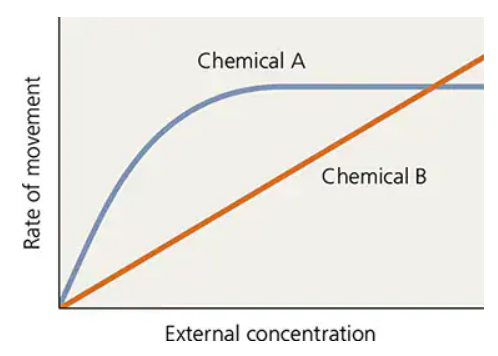
A scientist who is studying passive movement of chemicals across the cytoplasmic membrane of Salmonella enterica serotype Typhi measures the rate at which two chemicals diffuse into a cell as a function of external concentration. The results are shown in the following figure. Chemical A diffuses into the cell more rapidly than does B at lower external concentrations, but the rate levels off as the external concentration increases. The rate of diffusion of chemical B continues to increase as the external concentration increases.
Graph showing Chemical A's diffusion rate plateaus with concentration, while Chemical B's rate increases linearly.


a. How can you explain the differences in the diffusion rates of chemicals A and B?
b. Why does the diffusion rate of chemical A taper off?
c. How could the cell increase the diffusion rate of chemical A?
d. How could the cell increase the diffusion rate of chemical B?

Verified step by step guidance
1
Step 1: Analyze the graph to understand the diffusion behavior of chemicals A and B. Chemical A shows a rapid increase in diffusion rate at low external concentrations but then plateaus, indicating a maximum rate. Chemical B shows a steady, linear increase in diffusion rate with increasing external concentration.
Step 2: Explain the difference in diffusion rates by considering the mechanisms involved. Chemical A likely uses facilitated diffusion through a carrier protein or channel that becomes saturated at higher concentrations, causing the rate to level off. Chemical B likely diffuses by simple diffusion, where the rate is directly proportional to the concentration gradient and does not saturate.
Step 3: Understand why the diffusion rate of chemical A tapers off. The plateau occurs because the carrier proteins or channels responsible for its transport become fully occupied or saturated, limiting the maximum rate of diffusion regardless of further increases in external concentration.
Step 4: To increase the diffusion rate of chemical A, the cell could increase the number of carrier proteins or channels in the membrane, thereby increasing the maximum transport capacity and allowing more molecules to be transported simultaneously.
Step 5: To increase the diffusion rate of chemical B, since it diffuses by simple diffusion, the cell could increase the concentration gradient by either increasing the external concentration or decreasing the internal concentration, enhancing the driving force for diffusion.

Verified video answer for a similar problem:

This video solution was recommended by our tutors as helpful for the problem above.
Video duration:
5m
Was this helpful?

Key Concepts

Here are the essential concepts you must grasp in order to answer the question correctly.

Passive Diffusion vs Facilitated Diffusion

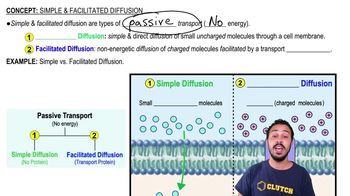
Passive diffusion is the movement of molecules across a membrane without assistance, driven by concentration gradients, and typically shows a linear increase in rate with concentration. Facilitated diffusion involves specific carrier proteins or channels that help molecules cross the membrane, leading to a saturation point where all carriers are occupied, causing the rate to level off.
Recommended video:
Guided course
05:10
Simple and Facilitated Diffusion

Saturation Kinetics in Membrane Transport

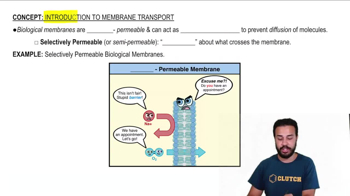
Saturation kinetics occur when transport proteins become fully occupied by their substrate, limiting the rate of movement across the membrane. This results in a plateau in the rate of diffusion despite increasing external concentration, as seen with chemical A, indicating a carrier-mediated process with finite capacity.
Recommended video:
Guided course
02:47
Introduction to Membrane Transport

Mechanisms to Increase Diffusion Rate

Cells can increase diffusion rates by either increasing the number of transport proteins (for facilitated diffusion) or by altering membrane permeability. For chemical A, increasing carrier proteins would raise the maximum rate, while for chemical B, which diffuses passively, increasing membrane fluidity or concentration gradient can enhance diffusion.
Recommended video: