Back

Normal Microbiota of the Urogenital System quiz

Control buttons has been changed to "navigation" mode.
1/15
  • What is microbial antagonism and why is it important in the urogenital system?

    Microbial antagonism is the protection provided by a healthy microbiome against pathogens; it prevents harmful microbes from establishing themselves in the urogenital system.
  • Is urine sterile? Explain your answer.

    No, urine is not sterile; bacteria such as Lactobacillus and Streptococcus are present in the urethra and bladder and can be found in urine.
  • Why is the urinary microbiome relatively small compared to other body sites?

    The urinary microbiome is small because urine has antimicrobial properties and the flushing action of urination removes microbes.
  • Which bacterial species are commonly found in the urinary system?

    Common species include Lactobacillus and Streptococcus, among others.
  • How does the diversity of the urinary microbiome differ between males and females?

    The urinary microbiome is more diverse in females and near the end of the urethra due to anatomical differences and easier access for microbes.
  • What factors contribute to the antimicrobial nature of urine?

    Urine contains ammonia, antimicrobial proteins, and is regularly flushed out, all of which contribute to its antimicrobial nature.
  • What is the main bacterial genus dominating the vaginal microbiome?

    Lactobacillus species dominate the vaginal microbiome.
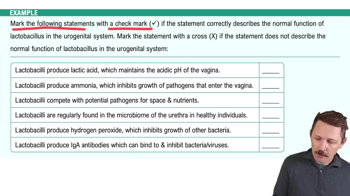
  • How do Lactobacillus species maintain an acidic environment in the vagina?

    Lactobacillus species convert glycogen from the vaginal walls into lactic acid, maintaining an acidic pH of 3.8–4.5.
  • What is the typical pH range of the vaginal environment?

    The vaginal environment typically has a pH range of 3.8 to 4.5.
  • What role do antimicrobial peptides and hydrogen peroxide play in the vaginal microbiome?

    They are produced by Lactobacillus and help control the growth of other bacteria, protecting against infections.
  • How does microbial antagonism in the vagina prevent infections?

    Microbial antagonism prevents pathogenic microbes from overgrowing by maintaining an acidic environment and producing antimicrobial substances.
  • Can Candida yeast be part of a healthy vaginal microbiome?

    Yes, Candida is present in about 10–25% of healthy vaginal microbiomes but can cause infections if it overgrows.
  • What is the source of glycogen used by Lactobacillus in the vagina?

    Glycogen is produced by the walls of the vagina and broken down into sugars for Lactobacillus to convert into lactic acid.
  • Why is microbial antagonism especially important in the vaginal microbiome?

    It is important because the vagina hosts many bacteria, and antagonism helps prevent infections and maintain reproductive health.
  • What innate defenses help maintain urinary and reproductive health?

    Innate defenses include antimicrobial properties of urine, flushing action, antimicrobial proteins, and microbial antagonism by resident bacteria.