Back

HPV & Genital Warts quiz

Control buttons has been changed to "navigation" mode.
1/15
  • What type of virus is HPV?

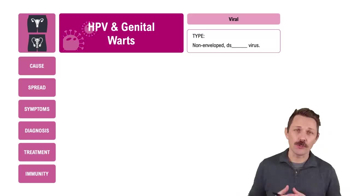
    HPV is a nonenveloped, double-stranded DNA virus.
  • How many types of HPV are there, and how many are sexually transmitted?

    There are over 200 types of HPV, with more than 40 being sexually transmitted.
  • What is the most common sexually transmitted infection in the United States?

    HPV is the most common sexually transmitted infection in the United States.
  • What percentage of sexually active people are estimated to be infected with HPV in their lifetime?

    About 80-90% of sexually active people will be infected with HPV during their lifetime.
  • What are genital warts and what causes them?

    Genital warts are benign epithelial growths caused by certain sexually transmitted types of HPV.
  • What is the incubation period for HPV infection?

    The incubation period for HPV infection is typically 3-4 months.
  • Why are most people unaware they have an HPV infection?

    Most HPV infections are asymptomatic, so people often do not know they are infected.
  • What cancers can persistent HPV infection lead to?

    Persistent HPV infection can lead to cervical, anal, oropharyngeal, penile, vaginal, and vulvar cancers.
  • How are genital warts diagnosed?

    Genital warts are diagnosed by visual inspection.
  • How is HPV detected in cases that may lead to cancer?

    HPV is detected through cervical cancer screening using a Pap smear.
  • What is the main cause of cervical cancer?

    HPV is the leading cause of cervical cancer.
  • What is the effectiveness of medications for genital warts?

    Medications can remove visible warts but do not clear the HPV infection itself.
  • What is the purpose of cervical cancer screening?

    Cervical cancer screening identifies high-risk HPV types and precancerous cells to treat them before cancer develops.
  • What is the HPV vaccine and who is it recommended for?

    The HPV vaccine protects against nine high-risk types and is recommended for adolescents, typically before sexual activity.
  • How does immunity from the HPV vaccine compare to natural infection?

    The HPV vaccine induces a stronger immune response than natural infection, greatly reducing genital warts and cervical cancer incidence.