Ch. 5 - Microbial Metabolism
Bauman - Microbiology with Diseases by Taxonomy 6th Edition
Bauman6th EditionMicrobiology with Diseases by TaxonomyISBN: 9780134832302Not the one you use?Change textbook
Chapter 5, Problem 6

Photosynthetic bacteria that also fix nitrogen are:
a. Mycoplasmas
b. Spirilla
c. Bacteroids
d. Cyanobacteria

Verified step by step guidance
1
Understand the key terms in the question: 'photosynthetic bacteria' are bacteria that can perform photosynthesis, and 'fix nitrogen' means converting atmospheric nitrogen (N₂) into a form usable by living organisms, such as ammonia.
Recall that mycoplasmas are bacteria without cell walls and are not known for photosynthesis or nitrogen fixation, so option (a) can be ruled out.
Spirilla are spiral-shaped bacteria, but they are not typically photosynthetic nor known for nitrogen fixation, so option (b) is unlikely.
Bacteroids are differentiated forms of rhizobia bacteria inside legume root nodules that fix nitrogen but are not photosynthetic, so option (c) is not correct.
Cyanobacteria are well-known for their ability to perform oxygenic photosynthesis and some species can fix nitrogen, making option (d) the correct choice.

Verified video answer for a similar problem:

This video solution was recommended by our tutors as helpful for the problem above.
Video duration:
1m
Was this helpful?

Key Concepts

Here are the essential concepts you must grasp in order to answer the question correctly.

Photosynthetic Bacteria

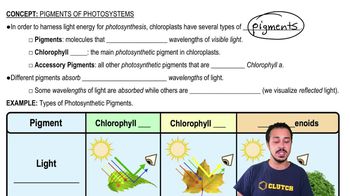
Photosynthetic bacteria are microorganisms that can convert light energy into chemical energy through photosynthesis. Unlike plants, some bacteria use different pigments and pathways, such as bacteriochlorophyll, to capture light. Cyanobacteria are a well-known group of photosynthetic bacteria that produce oxygen as a byproduct.
Recommended video:
Guided course
05:58
Pigments of Photosynthesis

Nitrogen Fixation

Nitrogen fixation is the biological process where certain bacteria convert atmospheric nitrogen (N2) into ammonia (NH3), a form usable by plants. This process is essential for the nitrogen cycle and supports plant growth. Some bacteria, including certain cyanobacteria, have specialized enzymes called nitrogenases to perform this function.
Recommended video:
Guided course
07:21
5 Nitrogenous Bases

Cyanobacteria

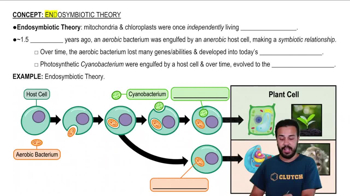
Cyanobacteria are a group of photosynthetic bacteria capable of oxygenic photosynthesis and nitrogen fixation. They possess specialized cells called heterocysts that provide an anaerobic environment for nitrogenase activity. Cyanobacteria play a crucial role in aquatic ecosystems and soil fertility by contributing both oxygen and fixed nitrogen.
Recommended video:
Guided course
06:58
Endosymbiotic Theory