Ch. 5 - Microbial Metabolism
Bauman - Microbiology with Diseases by Taxonomy 6th Edition
Bauman6th EditionMicrobiology with Diseases by TaxonomyISBN: 9780134832302Not the one you use?Change textbook
Chapter 5, Problem 6

Three common inorganic electron acceptors in anaerobic respiration are _______,_______, and _______.

Verified step by step guidance
1
Understand that anaerobic respiration uses electron acceptors other than oxygen to generate energy in the absence of oxygen.
Recall that common inorganic electron acceptors in anaerobic respiration include molecules that can accept electrons during the electron transport chain process.
Identify the three most common inorganic electron acceptors: nitrate (NO3^-), sulfate (SO4^{2-}), and carbon dioxide (CO2).
Recognize that nitrate is reduced to nitrite or nitrogen gas, sulfate is reduced to hydrogen sulfide, and carbon dioxide is reduced to methane in different microbial processes.
Summarize the answer by listing the three inorganic electron acceptors as nitrate, sulfate, and carbon dioxide.

Verified video answer for a similar problem:

This video solution was recommended by our tutors as helpful for the problem above.
Video duration:
1m
Was this helpful?

Key Concepts

Here are the essential concepts you must grasp in order to answer the question correctly.

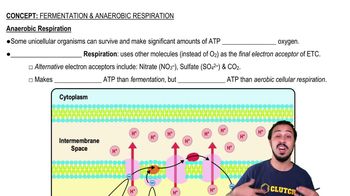
Anaerobic Respiration

Anaerobic respiration is a type of cellular respiration that occurs without oxygen, where organisms use inorganic molecules other than oxygen as terminal electron acceptors to generate energy.
Recommended video:
Guided course
03:35
Anaerobic Respiration

Electron Acceptors in Anaerobic Respiration

In anaerobic respiration, inorganic molecules such as nitrate, sulfate, and carbon dioxide serve as electron acceptors, allowing microbes to transfer electrons and produce energy in oxygen-free environments.
Recommended video:
Guided course
03:35
Anaerobic Respiration

Role of Inorganic Electron Acceptors

Inorganic electron acceptors like nitrate (NO3-), sulfate (SO4 2-), and carbon dioxide (CO2) enable microbes to sustain energy production by accepting electrons during the electron transport chain in the absence of oxygen.
Recommended video:
Guided course
07:41
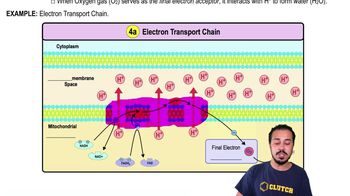
Electron Transport Chain