Ch. 10 - Host Microbe Interactions and Pathogenesis
Norman-McKay- Microbiology: Basic and Clinical Principles 2nd Edition
Norman-McKay2nd EditionMicrobiology: Basic and Clinical PrinciplesISBN: 9780137661619Not the one you use?Change textbook
Chapter 10, Problem 13

Make a Venn diagram to compare and contrast endotoxins and exotoxins.

Verified step by step guidance
1
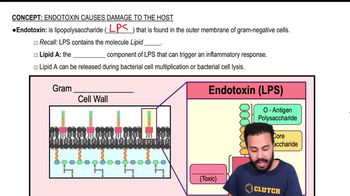
Step 1: Identify the key characteristics of endotoxins. These are toxins that are part of the outer membrane of Gram-negative bacteria, specifically lipopolysaccharides (LPS), and are released mainly when the bacteria die and the cell wall breaks apart.
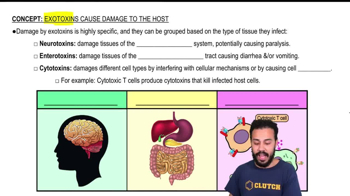
Step 2: Identify the key characteristics of exotoxins. These are proteins secreted actively by both Gram-positive and Gram-negative bacteria during their growth, and they often have specific targets and mechanisms of action.
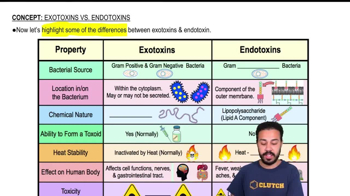
Step 3: Determine the unique features of endotoxins, such as their heat stability, general systemic effects (like fever and shock), and their role as pyrogens.
Step 4: Determine the unique features of exotoxins, including their high toxicity, ability to act enzymatically, and their specificity for certain cells or tissues (e.g., neurotoxins, enterotoxins).
Step 5: Identify the shared characteristics between endotoxins and exotoxins, such as both being bacterial toxins that contribute to disease symptoms, and both triggering immune responses in the host.

Verified video answer for a similar problem:

This video solution was recommended by our tutors as helpful for the problem above.
Video duration:
1m
Was this helpful?

Key Concepts

Here are the essential concepts you must grasp in order to answer the question correctly.

Endotoxins

Endotoxins are toxic components found in the outer membrane of Gram-negative bacteria, primarily lipopolysaccharides (LPS). They are released mainly when the bacteria die and the cell wall breaks down, causing strong immune responses such as fever and inflammation.
Recommended video:

Exotoxins

Exotoxins are proteins secreted by both Gram-positive and Gram-negative bacteria during their growth. They are highly potent, specific in their action, and can cause damage to host cells by targeting particular cellular functions or structures.
Recommended video:
Guided course
03:30
Types of Exotoxins

Comparison of Endotoxins and Exotoxins

Understanding the differences and similarities between endotoxins and exotoxins involves comparing their source, chemical nature, mode of release, toxicity, and effects on the host. This comparison helps clarify their roles in bacterial pathogenicity and immune system activation.
Recommended video:
Guided course
07:22
Exotoxins vs. Endotoxin Review