Pili, fimbriae, and sialic acid binding factors are examples of ________, which are virulence factors that allow pathogens to ________ host tissues––an essential early step in pathogenesis. In contrast, flagella, collagenases, and coagulases tend to act as ________, which help pathogens spread deeper into host tissues.
Ch. 10 - Host Microbe Interactions and Pathogenesis

Norman-McKay2nd EditionMicrobiology: Basic and Clinical PrinciplesISBN: 9780137661619Not the one you use?Change textbook
Chapter 10, Problem 10
A pathogen that makes endotoxin, enters through the fecal–oral route, and lacks a nucleus is most likely a
a. Virus.
b. Gram-positive bacterium.
c. Gram-negative bacterium.
d. Protozoan pathogen.
e. There is not enough information to answer this question.
Verified step by step guidance1
Step 1: Identify the key characteristics given in the problem: the pathogen produces endotoxin, enters through the fecal–oral route, and lacks a nucleus.
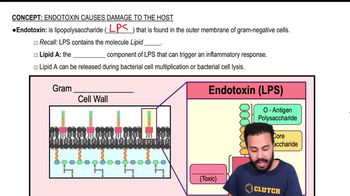
Step 2: Recall that endotoxins are components of the outer membrane of Gram-negative bacteria, specifically lipopolysaccharides (LPS), which are not produced by viruses, Gram-positive bacteria, or protozoa.
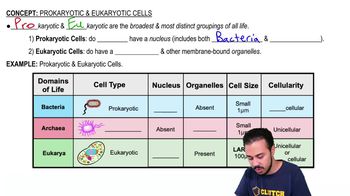
Step 3: Understand that organisms lacking a nucleus are prokaryotes, which include bacteria, while viruses and protozoa do not fit this description (viruses are acellular, protozoa are eukaryotic with nuclei).
Step 4: Combine these facts: since the pathogen produces endotoxin (a feature of Gram-negative bacteria) and lacks a nucleus (prokaryotic), it is most consistent with being a Gram-negative bacterium.
Step 5: Therefore, the best answer choice corresponds to the Gram-negative bacterium option.

Verified video answer for a similar problem:
This video solution was recommended by our tutors as helpful for the problem above.
Video duration:
1mWas this helpful?
Key Concepts
Here are the essential concepts you must grasp in order to answer the question correctly.
Endotoxins and Their Source
Endotoxins are toxic components found in the outer membrane of Gram-negative bacteria, specifically lipopolysaccharides (LPS). They are released when the bacterial cell wall breaks down, causing strong immune responses. Understanding endotoxins helps identify the type of pathogen involved.
Recommended video:
Guided course
Endotoxin
Fecal–Oral Route of Transmission
The fecal–oral route is a common transmission pathway where pathogens in fecal matter contaminate food or water and enter a new host through ingestion. Many gastrointestinal pathogens, including certain bacteria, viruses, and protozoa, spread this way, influencing infection control and diagnosis.
Recommended video:
Guided course
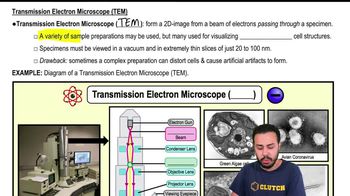
Transmission Electron Microscope (TEM)
Prokaryotic vs. Eukaryotic Cell Structure
Prokaryotes, such as bacteria, lack a nucleus, while eukaryotes, like protozoa, have a defined nucleus. Identifying whether a pathogen has a nucleus helps distinguish between bacterial and protozoan infections, which is critical for accurate classification and treatment.
Recommended video:
Guided course
Prokaryotic & Eukaryotic Cells
Related Practice
Textbook Question
1
views
Textbook Question
What is a reservoir, and why can C. difficile use a fomite as an effective environmental reservoir?
1
views
Textbook Question
Toxigenic microbes produce _______. A high ID50 would suggest _______, and a low LD50 would suggest _______.
Textbook Question
Which of the following is false regarding biofilms?
a. They tend to consist of one species of microbe.
b. They are platforms on which pathogens may adhere.
c. They form on indwelling devices.
d. They may harbor pathogens.
e. They can form on natural and manufactured surfaces.
2
views
Textbook Question
Complete the table:
1
views
Textbook Question
Make a Venn diagram to compare and contrast endotoxins and exotoxins.
3
views
