
Textbook Question
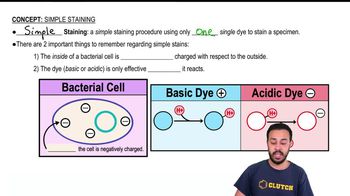
What is the purpose of a counterstain in the acid-fast stain?
1
views

 Verified step by step guidance

 02:10
02:10
 03:23
03:23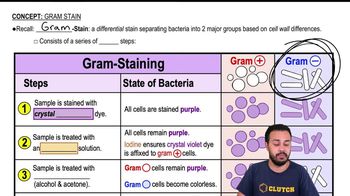 04:57
04:57What is the purpose of a counterstain in the acid-fast stain?
Why is a mordant used in the Gram stain? In the flagella stain?
The maximum magnification of a compound microscope is (a) ________; that of an electron microscope, (b) ________. The maximum resolution of a compound microscope is (c) ________; that of an electron microscope, (d) ________. One advantage of a scanning electron microscope over a transmission electron microscope is (e) ________.
Assume that you are viewing a Gram-stained field of red cocci and blue rods through the microscope. You can safely conclude that you have
a. Made a mistake in staining
b. Two different species
c. Old bacterial cells
d. Young bacterial cells
e. None of the above
Which of the following is not a functionally analogous pair of stains?
a. Nigrosin and malachite green
b. Crystal violet and carbolfuchsin
c. Safranin and methylene blue
d. Ethanol-acetone and acid-alcohol
e. All of the above pairs are functionally analogous.
Assume you stain Clostridium by applying a basic stain, carbolfuchsin, with heat, decolorizing with acid-alcohol, and counterstaining with an acidic stain, nigrosin. Through the microscope, the endospores are 1, and the cells are stained 2.
a. 1—red; 2—black
b. 1—black; 2—colorless
c. 1—colorless; 2—black
d. 1—red; 2—colorless
e. 1—black; 2—red