Ch. 15 - Microbial Mechanisms of Pathogenicity
Tortora - Microbiology: An Introduction 14th Edition
Tortora14th EditionMicrobiology: An IntroductionISBN: 9780138200398Not the one you use?Change textbook
Chapter 15, Problem 7

A drug that binds to mannose on human cells would prevent
a. the entrance of Vibrio enterotoxin.
b. the attachment of pathogenic E. coli.
c. the action of botulinum toxin.
d. streptococcal pneumonia.
e. the action of diphtheria toxin.

Verified step by step guidance
1
Step 1: Understand the role of mannose in microbial pathogenesis. Mannose residues on human cell surfaces often serve as binding sites for certain bacteria or their toxins, facilitating attachment or entry.
Step 2: Identify which pathogens or toxins specifically interact with mannose residues. For example, some pathogenic strains of Escherichia coli use mannose-sensitive fimbriae (pili) to attach to host cells.
Step 3: Analyze each option in the question to determine if the pathogen or toxin binds to mannose on human cells. For instance, Vibrio enterotoxin and botulinum toxin do not typically bind mannose; their mechanisms differ.
Step 4: Recognize that preventing binding to mannose would block the initial attachment step for pathogens that rely on mannose-mediated adhesion, such as certain pathogenic E. coli strains.
Step 5: Conclude that a drug binding to mannose would most likely prevent the attachment of pathogenic E. coli, as this bacterium uses mannose-sensitive adhesion to colonize host cells.

Verified video answer for a similar problem:

This video solution was recommended by our tutors as helpful for the problem above.
Video duration:
2m
Was this helpful?

Key Concepts

Here are the essential concepts you must grasp in order to answer the question correctly.

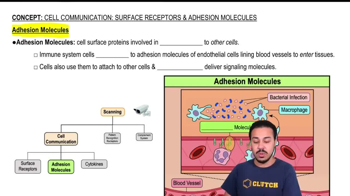
Role of Mannose in Bacterial Adhesion

Mannose residues on human cell surfaces serve as binding sites for certain bacterial adhesins, facilitating attachment. Pathogenic bacteria like some strains of E. coli use mannose-specific fimbriae to adhere to host cells, initiating infection. Blocking mannose can prevent this attachment, hindering colonization.
Recommended video:
Guided course
02:58
Adhesion Molecules

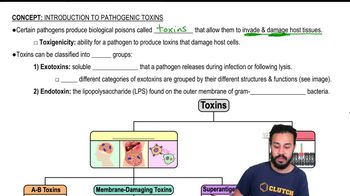
Mechanism of Bacterial Toxins

Bacterial toxins such as enterotoxins, botulinum, and diphtheria toxins have distinct modes of action, often independent of mannose binding. For example, botulinum toxin inhibits neurotransmitter release, while diphtheria toxin inhibits protein synthesis. Understanding these mechanisms helps differentiate toxin effects from adhesion processes.
Recommended video:
Guided course
03:40
Introduction to Pathogenic Toxins

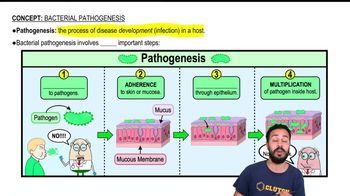
Pathogenesis of Vibrio and Streptococcal Infections

Vibrio enterotoxins cause diarrhea by disrupting ion transport in intestinal cells, but their entry does not rely on mannose binding. Streptococcal pneumonia involves bacterial colonization and immune evasion mechanisms unrelated to mannose-mediated adhesion. Recognizing these differences clarifies which pathogens are affected by mannose-binding drugs.
Recommended video:
Guided course
02:35
Intro to Bacterial Pathogenesis
Related Practice
Textbook Question

Compare and contrast the following aspects of endotoxins and exotoxins: bacterial source, chemistry, toxigenicity, and pharmacology. Give an example of each toxin.

4
views

Textbook Question

Label this diagram to show how the Shiga toxin enters and inhibits protein synthesis in a human cell.

1
views
Textbook Question

Describe the factors contributing to the pathogenicity of fungi, protozoa, and helminths.

7
views
Textbook Question

The earliest smallpox vaccines were infected tissue rubbed into the skin of a healthy

person. The recipient of such a vaccine usually developed a mild case of smallpox, recovered, and was immune thereafter. What is the most likely reason this vaccine did not kill more people?

a. Skin is the wrong portal of entry for smallpox.

b. The vaccine consisted of a mild form of the virus.

c. Smallpox is normally transmitted by skin-to-skin contact.

d. Smallpox is a virus.

e. The virus mutated.

1
views
Textbook Question

Which of the following genera is the most infectious?

1
views
Textbook Question

The ID₅₀ for Campylobacter sp. is 500 cells; the ID₅₀ for Cryptosporidium sp. is 100 cells. Which of the following statements is false?

a. Both microbes are pathogens.

b. Both microbes produce infections in 50% of the inoculated hosts.

c. Campylobacter is more virulent than Cryptosporidium.

d. Campylobacter and Cryptosporidium are equally virulent; they cause infections in the same number of test animals.

e. Cryptosporidium infections are acquired more easily than Campylobacter infections.