Ch. 15 - Microbial Mechanisms of Pathogenicity
Tortora - Microbiology: An Introduction 14th Edition
Tortora14th EditionMicrobiology: An IntroductionISBN: 9780138200398Not the one you use?Change textbook
Chapter 15, Problem 5

Compare and contrast the following aspects of endotoxins and exotoxins: bacterial source, chemistry, toxigenicity, and pharmacology. Give an example of each toxin.

Verified step by step guidance
1
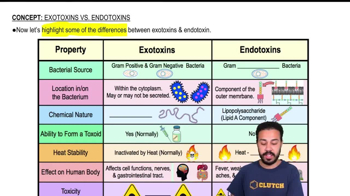
Identify the bacterial source of endotoxins and exotoxins: Endotoxins are typically part of the outer membrane of Gram-negative bacteria, whereas exotoxins are secreted by both Gram-positive and Gram-negative bacteria.
Describe the chemical nature of each toxin: Endotoxins are lipopolysaccharides (LPS), specifically the lipid A component, while exotoxins are proteins or polypeptides with enzymatic activity.
Explain toxigenicity differences: Exotoxins are highly potent and specific toxins that can cause disease even in small amounts, whereas endotoxins generally have lower toxicity and cause effects mainly when released in large quantities during bacterial cell lysis.
Discuss pharmacological effects: Exotoxins often have specific targets and mechanisms (e.g., neurotoxins, enterotoxins), leading to distinct clinical syndromes, while endotoxins trigger a generalized immune response, such as fever, inflammation, and septic shock.
Provide examples: For endotoxins, an example is the lipopolysaccharide from Escherichia coli; for exotoxins, examples include the botulinum toxin from Clostridium botulinum or diphtheria toxin from Corynebacterium diphtheriae.

Verified video answer for a similar problem:

This video solution was recommended by our tutors as helpful for the problem above.
Video duration:
3m
Was this helpful?

Key Concepts

Here are the essential concepts you must grasp in order to answer the question correctly.

Bacterial Source of Endotoxins and Exotoxins

Endotoxins are components of the outer membrane of Gram-negative bacteria, specifically lipopolysaccharides (LPS), released mainly when the bacteria die. Exotoxins are proteins secreted actively by both Gram-positive and Gram-negative bacteria during growth. Understanding the bacterial origin helps differentiate their roles in infection and immune response.
Recommended video:
Guided course
07:22
Exotoxins vs. Endotoxin Review

Chemistry and Toxigenicity of Endotoxins and Exotoxins

Endotoxins are lipopolysaccharides with relatively stable chemical structures and generally cause fever and inflammation but are less potent. Exotoxins are protein molecules, often enzymes, highly potent and specific in their toxic effects, such as neurotoxins or enterotoxins. Their chemical nature influences their mechanism and intensity of toxicity.
Recommended video:
Guided course
07:22
Exotoxins vs. Endotoxin Review

Pharmacology and Examples of Endotoxins and Exotoxins

Endotoxins trigger systemic effects like fever and shock by activating immune responses, but they are not neutralized by antitoxins. Exotoxins have specific targets and mechanisms, often neutralized by antitoxins or vaccines. Examples include Lipid A in endotoxins from E. coli and botulinum toxin as an exotoxin from Clostridium botulinum.
Recommended video:
Guided course
07:22
Exotoxins vs. Endotoxin Review
Related Practice