What do we mean when we say an enzyme is saturated with substrate? When an enzyme is saturated with substrate, how does adding more (a) substrate and (b) enzyme affect the rate of the reaction?
Ch.19 Enzymes and Vitamins
McMurry8th EditionFundamentals of General, Organic, and Biological ChemistryISBN: 9780134015187Not the one you use?Change textbook
Chapter 19, Problem 8
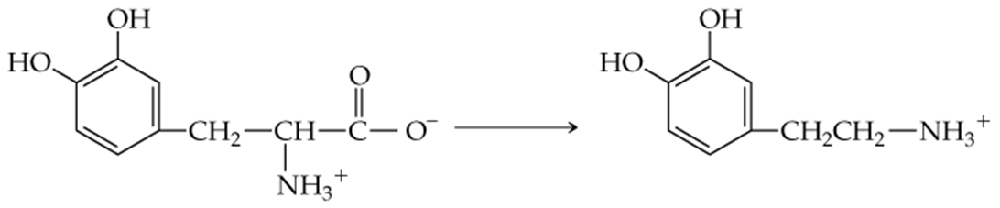
Which of the following reactions can be catalyzed by a decarboxylase?
a. 
b. 
Verified step by step guidance1
Identify the role of a decarboxylase enzyme: Decarboxylases are enzymes that catalyze the removal of a carboxyl group (-COOH) from a molecule, releasing it as carbon dioxide (CO₂). This typically involves breaking a C-C bond or a C-O bond in the carboxyl group.
Examine the chemical structures in the provided reactions: Look for a carboxyl group (-COOH) in the reactants and determine if it is being removed as CO₂ in the products. This is the hallmark of a decarboxylase-catalyzed reaction.
For each reaction, check if there is a loss of CO₂: Analyze the reactants and products to see if the molecular formula or structure indicates the release of CO₂. This can often be inferred from a decrease in the number of carbon atoms in the main molecule.
Determine if the reaction mechanism aligns with decarboxylation: Ensure that the reaction involves the enzymatic removal of a carboxyl group, as opposed to other types of reactions like oxidation, reduction, or hydrolysis.
Conclude which reaction(s) can be catalyzed by a decarboxylase: Based on the analysis of the chemical structures and the reaction mechanism, identify the reaction(s) that fit the criteria for decarboxylation.

Verified video answer for a similar problem:
This video solution was recommended by our tutors as helpful for the problem above.
Video duration:
1mWas this helpful?
Key Concepts
Here are the essential concepts you must grasp in order to answer the question correctly.
Decarboxylation
Decarboxylation is a chemical reaction that involves the removal of a carboxyl group (-COOH) from a molecule, releasing carbon dioxide (CO2). This process is crucial in various metabolic pathways, particularly in the conversion of amino acids to amines and in the Krebs cycle. Understanding this reaction is essential for identifying which substrates can be acted upon by decarboxylases.
Recommended video:
Guided course
Naming Dicarboxylic Acids Concept 3
Decarboxylases
Decarboxylases are a specific class of enzymes that catalyze decarboxylation reactions. They facilitate the removal of carboxyl groups from substrates, often playing a vital role in metabolic processes such as the synthesis of neurotransmitters. Recognizing the types of reactions these enzymes catalyze helps in determining the correct answer to the question.
Recommended video:
Guided course
Anaerobic Respiration Example 2
Substrate Specificity
Substrate specificity refers to the ability of an enzyme to selectively catalyze a reaction for a particular substrate or group of substrates. This concept is important in enzymology, as it determines which reactions can be catalyzed by a given enzyme, such as a decarboxylase. Understanding substrate specificity is key to analyzing the options presented in the question.
Recommended video:
Guided course
Specific Gravity
Related Practice
Textbook Question
Textbook Question
Which type of enzyme regulation is best for the following situations?
a. An enzyme that becomes overactive during a disease
b. An enzyme needed only when there is low blood glucose
c. An enzyme that springs into action when a traumatic injury occurs
d. An enzyme needed only during adolescence
Textbook Question
Identify and describe the chemical change in the lyase-catalyzed reaction in Table 19.4 that involves fumarate and malate. Identify the substrate(s) and product(s).
Textbook Question
Name the enzyme whose substrate is
a. Urea
1
views
Textbook Question
Describe the reactions that you would expect these enzymes to catalyze.
b. Aspartate transaminase
Textbook Question
What kind of reaction product might be a competitive inhibitor for the enzyme that catalyzes its formation?