Compare the structures of vitamin A and vitamin C. Which one is water-soluble and which is fat-soluble? What structural features does each have that make one water-soluble and the other fat-soluble?
Ch.19 Enzymes and Vitamins
McMurry8th EditionFundamentals of General, Organic, and Biological ChemistryISBN: 9780134015187Not the one you use?Change textbook
Chapter 19, Problem 16
Which type of enzyme regulation is best for the following situations?
a. An enzyme that becomes overactive during a disease
b. An enzyme needed only when there is low blood glucose
c. An enzyme that springs into action when a traumatic injury occurs
d. An enzyme needed only during adolescence
Verified step by step guidance1
Understand the concept of enzyme regulation: Enzyme regulation refers to the mechanisms that control the activity of enzymes, ensuring they function only when needed. Common types include allosteric regulation, covalent modification, feedback inhibition, and gene expression regulation.
For part (a): An enzyme that becomes overactive during a disease may require inhibition through covalent modification (e.g., phosphorylation) or the use of an allosteric inhibitor to reduce its activity. This ensures the enzyme does not contribute to disease progression.
For part (b): An enzyme needed only when there is low blood glucose is likely regulated by gene expression. The enzyme's production would be upregulated when blood glucose levels are low, ensuring it is synthesized only when required.
For part (c): An enzyme that springs into action during a traumatic injury is likely regulated by zymogen activation. Zymogens are inactive enzyme precursors that are activated in response to specific signals, such as those triggered by injury (e.g., blood clotting enzymes).
For part (d): An enzyme needed only during adolescence is likely regulated by hormonal control. Hormones such as growth hormone or sex hormones can regulate the expression of enzymes specific to developmental stages like adolescence.

Verified video answer for a similar problem:
This video solution was recommended by our tutors as helpful for the problem above.
Video duration:
9mWas this helpful?
Key Concepts
Here are the essential concepts you must grasp in order to answer the question correctly.
Enzyme Regulation
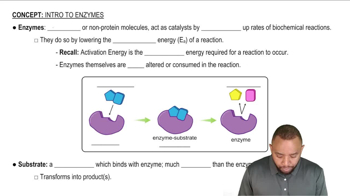
Enzyme regulation refers to the various mechanisms that control enzyme activity, ensuring that metabolic processes occur at the right time and in the right amounts. This can involve allosteric regulation, covalent modification, or feedback inhibition, allowing cells to respond dynamically to changes in their environment or internal conditions.
Recommended video:
Guided course
Intro to Enzymes Concept 1
Feedback Inhibition
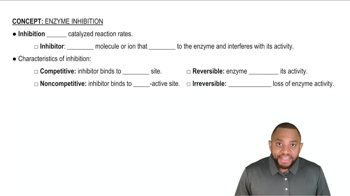
Feedback inhibition is a regulatory mechanism where the end product of a metabolic pathway inhibits an enzyme involved in its production. This process helps maintain homeostasis by preventing the overproduction of substances, making it particularly relevant for enzymes that become overactive during diseases.
Recommended video:
Guided course
Enzyme Inhibition Concept 1
Inducible Enzymes
Inducible enzymes are those that are synthesized in response to specific signals or conditions, such as low blood glucose levels. These enzymes are not constantly present but are produced when needed, allowing the organism to conserve resources and respond efficiently to changing physiological states.
Recommended video:
Guided course
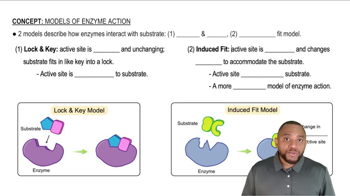
Models of Enzyme Action Concept 1
Related Practice
Textbook Question
Textbook Question
What do we mean when we say an enzyme is saturated with substrate? When an enzyme is saturated with substrate, how does adding more (a) substrate and (b) enzyme affect the rate of the reaction?
Textbook Question
Which of the following reactions can be catalyzed by a decarboxylase?
a.
b.
Textbook Question
Does the enzyme described in each of the following statements require a cofactor to be active?
c. The presence of K+ does not affect the reaction.
Textbook Question
Which vitamin provides us with each of the following?
b. Coenzyme A
Textbook Question
What kind of reaction product might be a competitive inhibitor for the enzyme that catalyzes its formation?