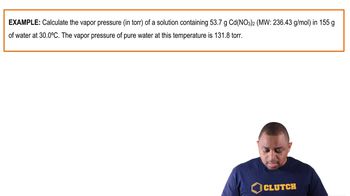
What is vapor pressure in the context of a liquid in a closed system?
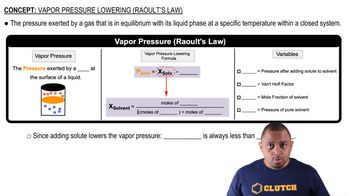
Vapor pressure is the pressure exerted by a gas that is in equilibrium with its liquid phase at a specific temperature within a closed system.
According to Raoult's law, what happens to the vapor pressure of a solvent when a solute is added?
The vapor pressure of the solvent decreases when a solute is added, resulting in vapor pressure lowering.
What is the formula for calculating the vapor pressure of a solution using Raoult's law?
P_solution = X_solvent × P°_solvent, where X_solvent is the mole fraction of the solvent and P°_solvent is the vapor pressure of the pure solvent.
In the formula for vapor pressure lowering, what does X_solvent represent?
X_solvent represents the mole fraction of the solvent in the solution.
What does the Van't Hoff factor (i) account for in Raoult's law?
The Van't Hoff factor (i) accounts for the dissociation of solute particles in the solution, affecting the mole fraction and vapor pressure.
How is the mole fraction of the solvent calculated in the context of vapor pressure lowering?
It is calculated as moles of solvent divided by (i × moles of solute + moles of solvent).
What does P°_solvent indicate in the vapor pressure lowering formula?
P°_solvent is the vapor pressure of the pure solvent, indicated by the degree sign.
Why is the pressure of a solution always less than the pressure of the pure solvent after adding a solute?
Adding a solute lowers the vapor pressure, so the solution's vapor pressure is always less than that of the pure solvent.
What physical processes occur at the surface of a liquid under vapor pressure?
Condensation and vaporization occur at the same rate at the surface, establishing equilibrium.
In the vapor pressure lowering formula, which term is multiplied by the Van't Hoff factor (i)?
The moles of solute are multiplied by the Van't Hoff factor (i).
What is a colligative property, and is vapor pressure lowering one of them?
A colligative property depends on the number of solute particles, not their identity; vapor pressure lowering is a colligative property.
What does the term 'solution' refer to in the context of Raoult's law?
A solution refers to the mixture formed when a solute is added to a solvent.
Why is it important to use the mole fraction of the solvent, not the solute, in Raoult's law?
Raoult's law specifically relates the vapor pressure to the mole fraction of the solvent, as it is the solvent that contributes to the vapor pressure.
What does the equilibrium between condensation and vaporization mean for vapor pressure?
It means the rate of molecules leaving the liquid equals the rate returning, resulting in a constant vapor pressure.
How does the presence of a non-volatile solute affect the vapor pressure of a solvent?
A non-volatile solute lowers the vapor pressure of the solvent by reducing the number of solvent molecules at the surface able to escape into the vapor phase.
 Back
Back
 02:40
02:40