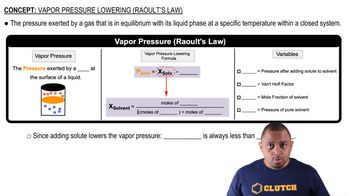
A principle stating that the vapor pressure of a solution is proportional to the mole fraction of the solvent and the vapor pressure of the pure solvent.
Vapor Pressure
The pressure exerted by a gas in equilibrium with its liquid phase at a specific temperature within a closed system.
Colligative Property
A characteristic of solutions that depends on the number of solute particles, not their identity, affecting properties like vapor pressure.
Mole Fraction
A ratio representing the moles of a component divided by the total moles in the solution, used to calculate solution properties.
Solvent
The component of a solution present in the greatest amount, responsible for dissolving the solute.
Solute
A substance dissolved in a solvent, forming a solution and affecting properties like vapor pressure.
Van't Hoff Factor
A value indicating the number of particles a solute produces in solution, impacting colligative properties.
Equilibrium
A state where condensation and vaporization occur at equal rates, resulting in constant vapor pressure.
Pure Solvent
A liquid without any dissolved solute, exhibiting the highest possible vapor pressure for that substance.
Solution
A homogeneous mixture formed when a solute is dissolved in a solvent, displaying altered physical properties.
Condensation
The process where gas molecules convert to liquid at the surface, balancing vaporization at equilibrium.
Vaporization
The process where liquid molecules escape into the gas phase, contributing to vapor pressure.
 Back
Back
 02:40
02:40