Indicate whether each statement is true or false: (a) The liquid crystal state is another phase of matter, just like solid, liquid, and gas. (b) Liquid crystalline molecules are generally spherical in shape. (d) Molecules that exhibit a liquid crystalline phase show weaker-than-expected intermolecular forces. (e) Molecules containing only carbon and hydrogen are likely to form liquid crystalline phases. (f) Molecules can exhibit more than one liquid crystalline phase.
Ch.11 - Liquids and Intermolecular Forces
Brown14th EditionChemistry: The Central ScienceISBN: 9780134414232Not the one you use?Change textbook
Chapter 11, Problem 64
At 25 °C gallium is a solid with a density of 5.91 g/cm3. Its melting point, 29.8 °C, is low enough that you can melt it by holding it in your hand. The density of liquid gallium just above the melting point is 6.1 g/cm3. Based on this information, what unusual feature would you expect to find in the phase diagram of gallium?
Verified step by step guidance1
Step 1: Understand the problem. The problem provides information about the density of gallium in its solid and liquid states. The density of solid gallium is less than the density of liquid gallium.
Step 2: Recall the general trend in phase diagrams. Typically, the solid phase of a substance is denser than its liquid phase. This is because particles in a solid are usually packed more closely together than in a liquid.
Step 3: Compare the general trend with the given information. In the case of gallium, the liquid phase is denser than the solid phase. This is contrary to the general trend.
Step 4: Predict the unusual feature in the phase diagram. Given that the liquid phase of gallium is denser than its solid phase, we would expect the phase diagram of gallium to show the solid-liquid boundary sloping to the right with increasing pressure. This is unusual because for most substances, the solid-liquid boundary in a phase diagram slopes to the left with increasing pressure.
Step 5: Understand the reason behind this unusual feature. The slope of the solid-liquid boundary in a phase diagram is determined by the relative densities of the solid and liquid phases. When the liquid phase is denser than the solid phase, as in the case of gallium, the solid-liquid boundary slopes to the right with increasing pressure. This is because under high pressure, the substance prefers to be in the denser phase, which is the liquid phase for gallium.

Verified video answer for a similar problem:
This video solution was recommended by our tutors as helpful for the problem above.
Video duration:
3mWas this helpful?
Key Concepts
Here are the essential concepts you must grasp in order to answer the question correctly.
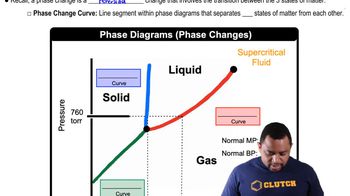
Phase Diagrams
A phase diagram is a graphical representation that shows the phases of a substance at various temperatures and pressures. It typically includes regions for solid, liquid, and gas phases, along with lines that indicate phase transitions. Understanding phase diagrams is crucial for predicting how a substance behaves under different conditions, particularly in terms of melting and boiling points.
Recommended video:
Guided course
Phase Changes in Diagrams
Density Anomalies
Density anomalies refer to the unusual behavior of certain substances where their solid form is less dense than their liquid form. For most materials, the solid phase is denser than the liquid phase, but in the case of gallium, the solid has a density of 5.91 g/cm³, while the liquid density is 6.1 g/cm³. This property can lead to unique features in the phase diagram, such as a negative slope in the melting curve.
Recommended video:
Guided course
Density Concepts
Melting Point and Phase Transition
The melting point is the temperature at which a solid becomes a liquid, marking a phase transition. For gallium, this occurs at 29.8 °C, which is relatively low compared to many metals. The phase transition from solid to liquid in gallium is significant because it can occur at temperatures that are easily achievable, influencing its applications and the shape of its phase diagram.
Recommended video:
Guided course
Boiling Point and Melting Point
Related Practice
Textbook Question
Textbook Question
Use the phase diagram of neon to answer the following questions. (a) What is the approximate value of the normal boiling point?
Textbook Question
Use the phase diagram of neon to answer the following questions. (b) What can you say about the strength of the intermolecular forces in neon and argon based on the critical points of Ne and Ar (see Table 11.5.)?
1
views
Textbook Question
The phase diagram for neon is
Use the phase diagram to answer the following questions. (a) What is the approximate value of the normal melting point?
1
views
