Referring to Figure 11.29, describe the phase changes (and the temperatures at which they occur) when CO2 is heated from -80 to -20°C at (a) a constant pressure of 3 atm,
Ch.11 - Liquids and Intermolecular Forces
Brown14th EditionChemistry: The Central ScienceISBN: 9780134414232Not the one you use?Change textbook
Chapter 11, Problem 62a
Use the phase diagram of neon to answer the following questions. (a) What is the approximate value of the normal boiling point?
Verified step by step guidance1
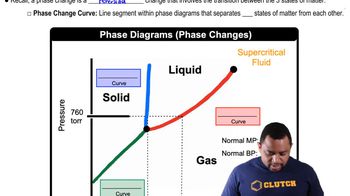
Understand the concept of a phase diagram: A phase diagram is a graphical representation of the physical states of a substance under different conditions of temperature and pressure. It typically includes lines that separate different phases such as solid, liquid, and gas.
Identify the normal boiling point: The normal boiling point is the temperature at which a substance transitions from liquid to gas at 1 atmosphere of pressure.
Locate the phase diagram for neon: You will need to refer to a phase diagram specific to neon, which shows the relationship between temperature and pressure for its different phases.
Find the point on the phase diagram where the liquid-gas boundary intersects with the line representing 1 atmosphere of pressure. This intersection point indicates the normal boiling point of neon.
Read the temperature value at this intersection: The temperature at this point on the phase diagram is the approximate value of the normal boiling point of neon.

Verified video answer for a similar problem:
This video solution was recommended by our tutors as helpful for the problem above.
Video duration:
2mWas this helpful?
Key Concepts
Here are the essential concepts you must grasp in order to answer the question correctly.
Phase Diagram
A phase diagram is a graphical representation that shows the states of a substance (solid, liquid, gas) at various temperatures and pressures. It helps in understanding the conditions under which a substance will exist in different phases and indicates critical points, such as the boiling point and melting point.
Recommended video:
Guided course
Phase Changes in Diagrams
Normal Boiling Point
The normal boiling point of a substance is the temperature at which it transitions from a liquid to a gas at a pressure of 1 atmosphere (atm). This value is significant as it provides insight into the substance's volatility and intermolecular forces, with lower boiling points indicating weaker forces.
Recommended video:
Guided course
Boiling Point Elevation
Intermolecular Forces
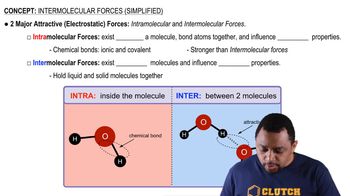
Intermolecular forces are the forces of attraction or repulsion between molecules. They play a crucial role in determining the physical properties of substances, including boiling and melting points. In the case of neon, a noble gas, the weak London dispersion forces influence its phase transitions.
Recommended video:
Guided course
Intermolecular vs Intramolecular Forces
Related Practice
Textbook Question
1
views
Textbook Question
(b) Could you measure the triple point of water by measuring the temperature in a vessel in which water vapor, liquid water, and ice are in equilibrium under 1 atm of air? Explain.
1
views
Textbook Question
Use the phase diagram of neon to answer the following questions. (b) What can you say about the strength of the intermolecular forces in neon and argon based on the critical points of Ne and Ar (see Table 11.5.)?
1
views
Textbook Question
At 25 °C gallium is a solid with a density of 5.91 g/cm3. Its melting point, 29.8 °C, is low enough that you can melt it by holding it in your hand. The density of liquid gallium just above the melting point is 6.1 g/cm3. Based on this information, what unusual feature would you expect to find in the phase diagram of gallium?
1
views
Textbook Question
The phase diagram for neon is
Use the phase diagram to answer the following questions. (a) What is the approximate value of the normal melting point?
1
views