 Back
BackMolecular Shapes & Valence Bond Theory: Step-by-Step Study Guidance
Study Guide - Smart Notes
 Tailored notes based on your materials, expanded with key definitions, examples, and context.
Q1. Identify the central atom and number of electron domains for each ion shown below:
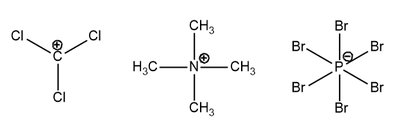
Background
Topic: Valence Shell Electron Pair Repulsion (VSEPR) Theory
This question tests your understanding of how to identify the central atom in a polyatomic ion and count the number of electron domains (regions of electron density) around it. Electron domains include both bonding pairs (single, double, or triple bonds) and lone pairs of electrons.
Key Terms and Formulas:
Central atom: The atom in a molecule or ion to which other atoms are bonded.
Electron domain: A region around a central atom where electrons are likely to be found; includes bonds and lone pairs.
VSEPR theory: Predicts the shape of molecules based on minimizing repulsion between electron domains.
Step-by-Step Guidance
For each ion, identify the central atom (the atom to which all other atoms are bonded).
Count the number of atoms directly bonded to the central atom (each bond counts as one domain, regardless of whether it is single, double, or triple).
Count the number of lone pairs on the central atom (each lone pair is also an electron domain).
Add the number of bonded atoms and lone pairs to get the total number of electron domains for each ion.
Try solving on your own before revealing the answer!
