Ch. 4 - Inverse, Exponential, and Logarithmic Functions
Lial - College Algebra 13th Edition
Lial13th EditionCollege AlgebraISBN: 9780136881063Not the one you use?Change textbook
Chapter 5, Problem 7

Solve each equation. Round answers to the nearest hundredth as needed. (1/4)x=64

Verified step by step guidance
1
Recognize that the equation is an exponential equation of the form \(\left(\frac{1}{4}\right)^x = 64\).
Rewrite both sides of the equation with the same base if possible. Note that \(\frac{1}{4}\) can be written as \(4^{-1}\), and \(64\) can be expressed as a power of 4 since \(64 = 4^3\).
Substitute these expressions back into the equation to get \(\left(4^{-1}\right)^x = 4^3\).
Use the power of a power property: \(\left(a^m\right)^n = a^{mn}\), so rewrite the left side as \(4^{-x} = 4^3\).
Since the bases are the same and the expressions are equal, set the exponents equal to each other: \(-x = 3\). Then solve for \(x\).

Verified video answer for a similar problem:

This video solution was recommended by our tutors as helpful for the problem above.
Video duration:
3m
Was this helpful?

Key Concepts

Here are the essential concepts you must grasp in order to answer the question correctly.

Exponential Equations

Exponential equations involve variables in the exponent position, such as (1/4)^x = 64. Solving these requires understanding how to manipulate and isolate the variable in the exponent to find its value.
Recommended video:
5:47
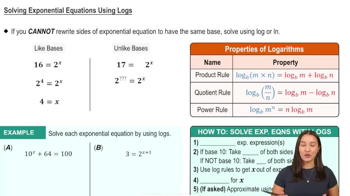
Solving Exponential Equations Using Logs

Properties of Exponents

Properties of exponents, like a^(m) * a^(n) = a^(m+n) and (a^m)^n = a^(mn), help simplify and rewrite expressions. Recognizing equivalent bases allows rewriting both sides of the equation to solve for the exponent.
Recommended video:
Guided course
04:06
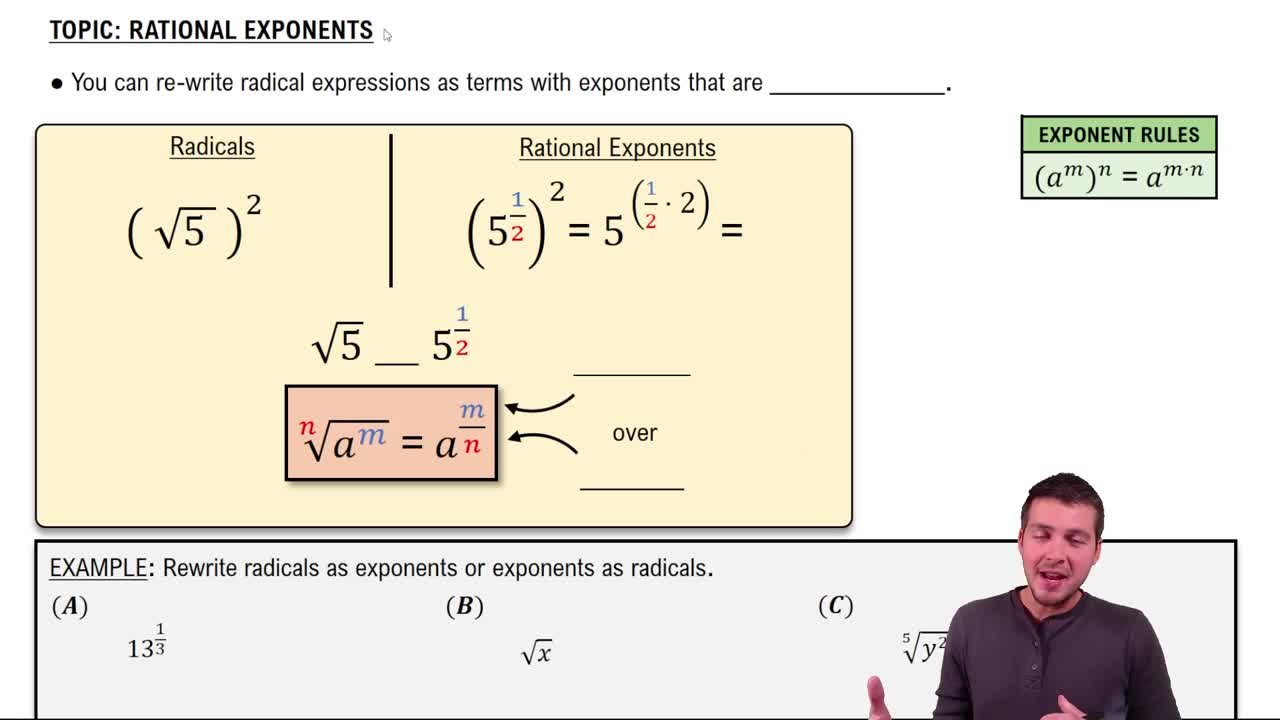
Rational Exponents

Logarithms

Logarithms are the inverse operations of exponentials and are used to solve equations where the variable is an exponent. Applying logarithms to both sides helps isolate the exponent and solve for the variable.
Recommended video:
7:30
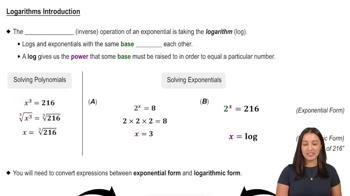
Logarithms Introduction