Ch. 4 - Inverse, Exponential, and Logarithmic Functions
Lial - College Algebra 13th Edition
Lial13th EditionCollege AlgebraISBN: 9780136881063Not the one you use?Change textbook
Chapter 5, Problem 1

Fill in the blank(s) to correctly complete each sentence. If ƒ(x) = 4x, then ƒ(2) = and ƒ(-2) = ________.

Verified step by step guidance
1
Identify the given function: \(f(x) = 4^x\), which means the function raises 4 to the power of \(x\).
To find \(f(2)\), substitute \(x = 2\) into the function: \(f(2) = 4^{2}\).
Calculate the expression \$4^{2}$ by multiplying 4 by itself twice (though we won't compute the final value here).
To find \(f(-2)\), substitute \(x = -2\) into the function: \(f(-2) = 4^{-2}\).
Recall that a negative exponent means taking the reciprocal: \(4^{-2} = \frac{1}{4^{2}}\). This completes the expression for \(f(-2)\).

Verified video answer for a similar problem:

This video solution was recommended by our tutors as helpful for the problem above.
Video duration:
2m
Was this helpful?

Key Concepts

Here are the essential concepts you must grasp in order to answer the question correctly.

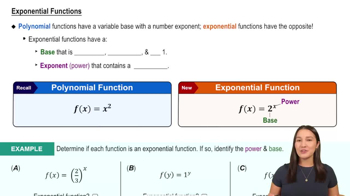
Exponential Functions

An exponential function has the form f(x) = a^x, where the base a is a positive constant. The function grows or decays depending on the base, and the exponent x can be any real number. Understanding how to evaluate these functions at specific values of x is essential.
Recommended video:
6:13
Exponential Functions

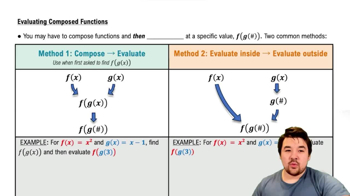
Evaluating Functions at Given Inputs

To find f(c) for a function f(x), substitute the input value c into the function in place of x. This process involves performing the necessary arithmetic operations to simplify and find the output value corresponding to the input.
Recommended video:
4:26
Evaluating Composed Functions

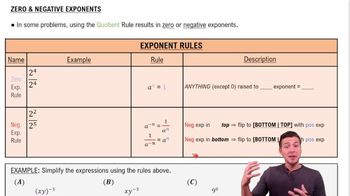
Negative Exponents

A negative exponent indicates the reciprocal of the base raised to the positive exponent, i.e., a^{-n} = 1 / a^n. This rule is crucial when evaluating exponential functions at negative inputs, ensuring correct calculation of values like f(-2).
Recommended video:
Guided course
6:37
Zero and Negative Rules